When the Romans fought a Dragon
Or did they?
Dragons seem to have had a large presence on the minds of the pre-modern people. Greeks, Romans, Jews, Persians, Indians, Chinese, Ancient Meso-Americans, all seem to have some variations of the dragon. At least when reading in English, that is. Taking a closer look may reveal at once that many mythical and legendary creatures, with great variations between them, are often lumped together under the label ‘dragon’. And that just with the pre-modern people, modern dragons seen in fantasy books and movies are sometimes very far from their folkloric counterparts. Modern fantasy dragons seem to me to be more comparable to a fighter jet laying low cities than to the large reptile-like creatures of ancient and medieval folklore.
The English word ‘dragon’ comes (by the way of French) from the Latin ‘dracō’ which ultimately comes from the Greek ‘δράκων’(drákōn). So, its clear the Greeks and Romans knew about the dragon, right ?
Well, maybe not. The primary meaning of ‘δράκων’/’dracō’ in both Greek and Latin is a serpent. So, sometimes authors writing about the same beast use these words with other, more straightforward words for serpents. Due to the etymological links, however, many translators (especially earlier ones) have a tendency to use the word ‘dragon’ to translate into English where the Greek or Latin might just as well be translated as a serpent.
The most famous of the ‘dragons’ that the Romans encountered is probably the Bagradas Dragon. In the midst of the otherwise historical narrative of the First Punic War (264–241 BC), we are told that a Roman army under the Atilius Regulus (consul 256/255[1] BC) encountered a serpent of incredible size near the Bagradas river in what is now Tunisia.
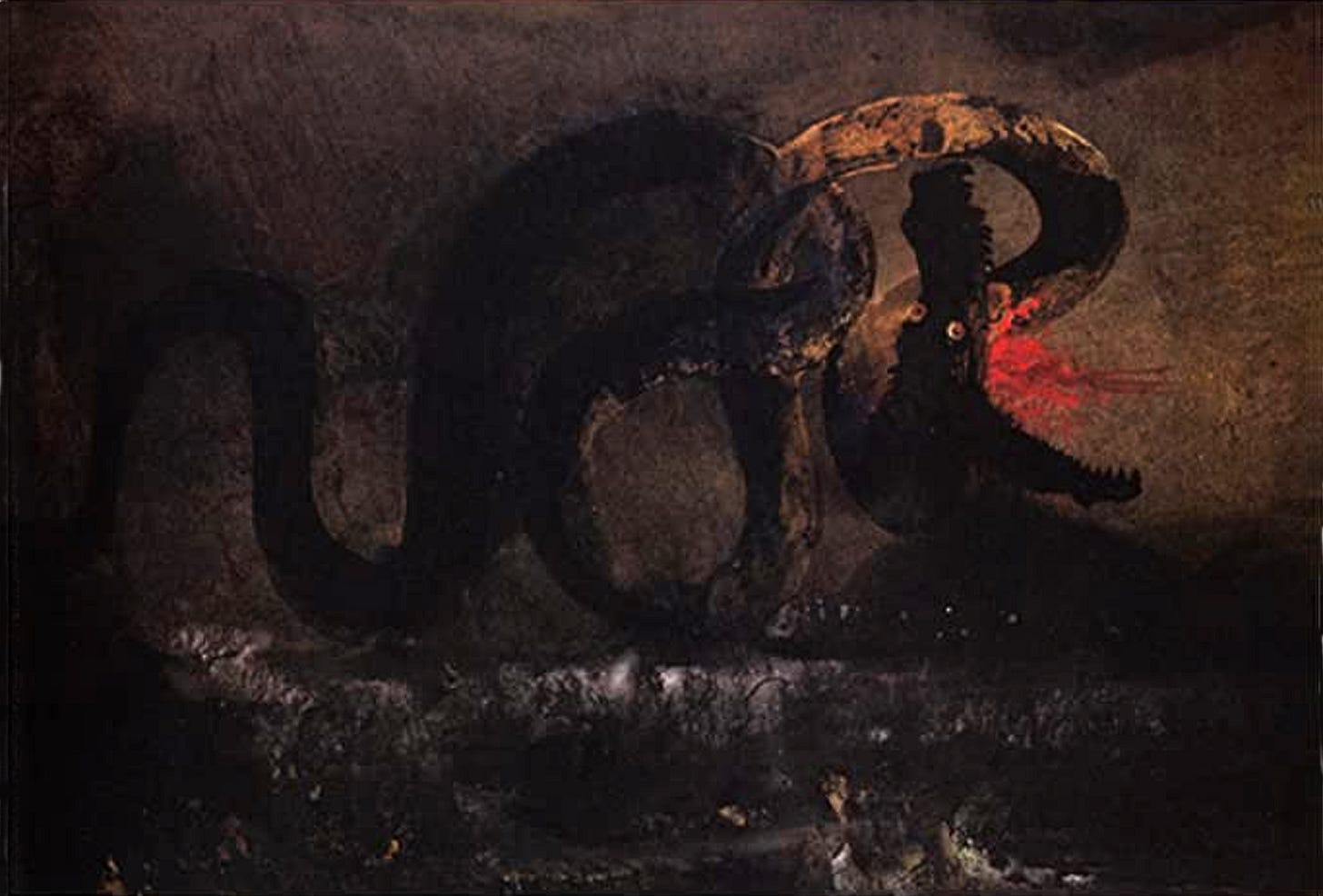
Fig: The Serpent by Victor Hugo (1866)
I had read about it before but it came back to me while reading the Aulus Gellius’ Attic Nights, a sort of compilation of anecdotes and interesting information as they seemed to a 2nd century aristocratic Roman writer. Thus, in the seventh book, he writes: [2]
Historia sumpta ex libris Tuberonis de serpente invisitatae longitudinis.
1 Tubero in historiis scriptum reliquit bello primo Poenico Atilium Regulum consulem in Africa castris apud Bagradam flumen positis proelium grande atque acre fecisse adversus unum serpentem in illis locis stabulantem invisitatae inmanitatis eumque magna totius exercitus conflictione balistis atque catapultis diu oppugnatum, eiusque interfecti corium longum pedes centum et viginti Romam misisse. (Noctes Atticae 7.3)
A story taken from the books of Tubero regarding a Serpent of unprecedented length.
Tubero has left an account in his Histories that in the First Punic War, the consul Atilius Regulus, when encamped near the Bagradas river in Africa, fought a grand and fierce battle against a serpent of unprecedented length that was dwelling in those regions. With the whole army, he attacked the serpent with bolt throwers and catapults for a long time and (after killing it) sent its skin, measuring one hundred and twenty feets, to Rome.
Though the Roman foot is a little shorter than the Imperial foot[3], that still is truly a serpent of ‘unprecedented length’.
This is not the only ancient account of the Bagradas Serpent. Livy probably covered it in his account of the First Punic War. The books of Livy’s history that covered the First Punic Wars are lost but Valerius Maximus in his Memorable Deeds and Saying paraphrases Livy as saying :
Quae quia supra usitatam rationem excedentia attigimus, serpentis quoque a T. Liuio curiose pariter ac facunde relatae fiat mentio: is enim ait in Africa apud Bagradam flumen ... tantae magnitudinis fuisse, ut Atilii Reguli exercitum usu amnis prohiberet, multisque militibus ingenti ore correptis, conpluribus caudae uoluminibus elisis, cum telorum iactu perforari nequiret, ad ultimum ballistarum tormentis undique petitam silicum crebris et ponderosis uerberibus procubuisse omnibusque et cohortibus et legionibus ipsa Karthagine uisam terribiliorem, atque etiam cruore suo gurgitibus inbutis corporisque iacentis pestifero adflatu uicina regione polluta Romana inde summouisse castra. adicit beluae corium centum et uiginti pedum in urbem missum.
As we have touched the subject of things beyond the usual measure, it is fit to mention the Serpent that has been curiously and skillfully related by T. Livy. He says that near the Bagradas river in Africa …. that it was of such magnitude that it would stop the army of Atilius Regulus from using the river. It seized many soldiers with its enormous mouth and many with its great tail and could not be penetrated with the javelins, but at last it was brought down with the missiles and weighty throws of stones. The serpent seemed to the legions and the cohorts to be more terrifying than Carthage itself. The Roman camp was moved as the flows of its blood in the whirls polluted the surrounding region. The skin of the beast , measuring one hundred and twenty feets, was sent to the city.
Although the part of Livy’s history dealing with this is lost, a periocha (summary) survives. So, in the summary of the eighteenth book of Livy’s history, we read:
Atilius Regulus in Africa serpentem portentosae magnitudinis cum magna clade militum occidit, et cum aliquot proeliis bene aduersus Carthaginienses pugnasset ….
When Atilius Regulus had killed a serpent of ominous magnitude in Africa with great loss of soldiers, and had fought some battles well against the Carthaginians, ….
The most detailed Latin source from antiquity describing the Serpent comes from the Sixth Book of Silius Italicus’ Punica, a rather long epic poem on the Second Punic War. It is rather too long to be translated here. It covers more or less the same ground as the accounts given by the historians, though it expectedly is more vivid. There are some incidental mentions in the epitome-writers (Eutropius and others) and a long account in Osorius’ History against the Pagans (Historiae Adversus Paganos) which is quite long but likewise derivative.
Regulus, bellum Carthaginiense sortitus, iter cum exercitu faciens haud procul a flumine Bagrada castra constituit: ubi cum plurimos militum aquandi necessitate ad flumen descendentes serpens mirae magnitudinis deuoraret, Regulus ad expugnandam bestiam cum exercitu profectus est. 11 sed nihil in tergo eius proficientibus iaculis atque omni telorum ictu inrito, quae per horrendam squamarum cratem quasi per obliquam scutorum testudinem labebantur mirumque in modum, ne corpus laederent, ipso corpore pellebantur, cum insuper magnam multitudinem morsu conminui, impetu proteri, halitu etiam pestifero exanimari uideret, ballistas deferri imperauit, per quas murale saxum spinae eius incussum conpagem totius corporis soluit. 12 talis siquidem est natura serpentis, ut, cum pedibus carere uideatur, costis tamen et squamis, quas a summo gutture usque ad imam aluum parili modo dispositas habet, ita instruitur, ut squamis quasi unguibus, costis quasi cruribus innitatur. 13 non enim ut uermis, cui spinae rigor non est, et in directum corpusculi sui partes gradatim porrigendo contractas, contrahendo porrectas motum explicat, sed alternis intenta conatibus latera sinuosa circumfert, ut per exteriorem spinae curuaturam rigentem costarum aciem tendat, costis autem natura ad summum rectis squamarum ungulas figat; quod uicissim et celeriter agendo non solum plana perlabitur, sed etiam conuexa conscendit, tot uestigiis instructa quot costis. 14 huius itaque rei causa est, ut, si in qualibet corporis parte ab aluo usque ad caput ictu aliquo conlidatur, debilis reddita cursum habere non possit; quia ubicumque ille ictus inciderit spinam soluit, per quam costarum pedes et motus corporis agebantur. unde etiam haec serpens, quae tamdiu tot iaculis inuulnerabilis obstitit, ad unius saxi ictum debilis cessit ac mox circumuenta telis facile oppressa est. 15 corium autem eius Romam deuectum - quod fuisse centum uiginti pedum spatio ferunt - aliquamdiu cunctis miraculo fuit.
( Historiae Adversus Paganos 4.08.10-15)
Or in English:[4]
10 Regulus, chosen by lot for the Carthaginian War, marched with his army to a point not far from the Bagrada River and there pitched his camp. In that place a reptile of astonishing size devoured many of the soldiers as they went down to the river to get water. Regulus set out with his army to attack the reptile. 11 Neither the javelins they hurled nor the darts they rained upon its back had any effect. These glided off its horrible scaly fins as if from a slanting testudo of shields and were in some miraculous fashion turned away from its body so that the creature suffered no injury. Finally, when Regulus saw that it was killing a great number of his soldiers with its bites, was trampling them down by its charge, and driving them mad by its poisonous breath, he ordered ballistae brought up. A stone taken from a wall was hurled by a ballista; this struck the spine of the serpent and caused its entire body to become numb. 12 The formation of the reptile was such that, though it seemed to lack feet, yet it had ribs and scales graded evenly, extending from the top of its throat to the lowest part of its belly and so arranged that the creature rested upon its scales as if on claws and upon its ribs as if on legs. 13 But it did not move like the worm which has a flexible spine and moves by first stretching its contracted parts in the direction of its tiny body and then drawing together the stretched parts. This reptile made its way by a sinuous movement, extending its sides first right and then left, so that it might keep the line of ribs rigid along the exterior arch of the spine; nature fastened the claws of its scales to its ribs, which extend straight to their highest point; making these moves alternately and quickly, it not only glided over levels, but also mounted inclines, taking as many footsteps, so to speak, as it had ribs. This is why the stone rendered the creature powerless. 14 If struck by a blow in any part of the body from its bowels to its head, it is crippled and unable to move, because wherever the blow falls, it numbs the spine, which stimulates the feet of the ribs and the motion of the body. Hence this serpent, which had for a long time withstood so many javelins unharmed, moved about disabled from the blow of a single stone and, quickly overcome by spears, was easily destroyed. 15 Its skin was brought to Rome - it is said to have been one hundred and twenty feet in length - and for some time was an object of wonder to all.
So, what are we to make of all this ? It is of course perfectly reasonable to consider all this talk about giant snakes being fought with catapults bunch of nonsense. This is generally the position that historians in the 19th and 20th centuries tended to take. The examples of these are plentiful and easy to find. This, for example, is taken from book published in 1892, introducing excerpts from Gellius:
There is a total lack of discrimination as to the value of what was recorded, and it is surprising to find in the same collection the priceless account of the conversation of Caecilius and Favorinus on the laws of the Twelve Tables and such an absurdity as the tale of the gigantic serpent which Regulus' army could subdue only by the use of catapults.
What indeed to make of it ? Was it a real serpent or just a myth? Polybius’s Histories is the best source we have for the First Punic War but the Serpent incident is not present in it. So, it could be all bunk anyway. A 19th century historian[5] went so far as to claim that the whole episode could be an invention of the poet Naevius for his Epic on the First Punic War which unfortunately doesn’t survive to us today. Naevius had himself participated in the war. So, even with all sort of drawbacks of following epic conventions, it would have been a significant contemporary source to historians. Later on, multiple ancient authors relate not only the story of the Bagradas dragon but also specifically note that the skin of the beast was transferred to Rome. Pliny the Elder states that the skin survived up until the Numantine War (143-133 BC):
nota est in Punicis bellis ad flumen Bagradam a Regulo imperatore ballistis tormentisque, ut oppidum aliquod, expugnata serpens CXX pedum longitudinis; pellis eius maxillaeque usque ad bellum Numantinum duravere Romae in templo.
Historia Naturalis 8.37
It is known that during the Punic Wars a snake 120 feet long was fought, besieged like a town with siege engines and artilleries under the leadership of Regulus near Bagradas river. Its skin and jawbones endured in a temple in Rome up to the Numantine war.
The question is, of course, not whether a serpent actually the size as described by the ancient authors did exist but whether there is even a more mundane truth behind the story. Even the longest snake verifiably measured in modern times do not go beyond 30 feet and these are usually some type of Python. There were longer snakes in history, like Titanoboa which could perhaps grow as long as 50ft but they usually lived much far back in past in the Paleocene, millions of years ago and not in Roman times. It is very, very unlikely that the serpents in Roman times were much larger than in our own even if one were to assume that some sort of Python, usually found in more tropical habitats, had somehow found its way to Maghreb. On the other hand, it is possible that the Romans did encounter snakes which were somewhat larger than usual and the tale grew in its telling as tales so often do.
Or it could be that some sort of prehistoric fossils were deposited in times gone by in some Roman temple and only later did the legend attach itself to a real historic figure. Many Myths associated with what are likely prehistoric remains were not unknown in classical antiquity. Herodotus[6] relates a story about how when the Spartans weren’t able to defeat the Tegeans after even many attempts, they consulted the oracle at Delphi where the god ordered them to retrieve the bones of Orestes, son of Agamemnon, and to rebury them in Sparta. Spartans finally manage to locate the burial of Orestes and do bring the remains to Sparta. Orestes’ remains are said to be some 7 cubit long. Assuming 18.2 inches for a cubit that I get from the internet, Orestes would then have to be greater than 10 foot. If the story is historical, the remains could be of some prehistoric animal. Similar ‘burial’ sites of other mythical figure were not uncommon and were usually associated with hero-cults.
I am skeptical of general claims that the stories of dragons were based on prehistoric people finding dinosaur remains and misinterpreting them but there obviously were some findings, and some stories based on fossil finds. Whatever else they may have derived inspiration from, dragons, even the later less snaky ones, seem to me to be at least partly based on real snakes and not fossils. Even real snakes spit out fire(y venom) after all.
Scholarly assessments of the Bagradas dragon incident seems consist usually of either the denial of any truth behind the story at all or some sort of exaggeration. Stories about large serpents are not rare in ancient authors. Maximus of Tyre even reports one in India that was apparently 5 plethra (500 feet) long. Stothers (2004)[7] is the most non dismissive of the ones I read though this may be because he wasn’t a professional classicist.
Whatever the origin of the story, I think it does illustrate a pretty interesting point about the Roman ethos. Unlike many other dragon-slaying myths in other cultures (and even in more mythic Roman ones), the Bagradas dragon is not slain by a great dragon slaying hero. Instead, it is, as Pliny says, sacked by a Roman legion as they would sack a city. The glory belongs primarily not to him but to Rome itself where the skin of the beast is sent for display. There is no Thor smiting the Midgard Serpent or Indra killing Vṛtrá, Romans just grind the damn thing out with siege engines.

Romans after seeing a 120 feet long snake. 255 BCE. Colorized.
The role of this episode within the larger narrative of the First Punic War is also worth noting. Regulus’ campaign against the Carthaginians, although initially successful, ends in a failure. The Carthaginians employ a Spartan mercenary commander named Xanthippus. In the Battle of the Bagradas river, Romans are defeated and Regulus himself taken captive. The Carthaginians send him back to Rome on the condition that he should convince the Roman Senate to stop pursing the war further. Regulus instead argues with full force for continuing the war before returning to Carthage as stipulated where he is promptly tortured to death. For the Romans of late republic Regulus was a sort of heroic defenders of the Republic like Brutus or Cincinnatus or Camillus who would rather get tortured and die while keeping his word rather than give in to the enemies of the Republic. There are also theories that in early times his story may have been a cautionary tale of over-proud generals, though I’m not sure how supported this idea is. That the snake incident takes place immediately before Regulus’ capture and death is interesting in any case.
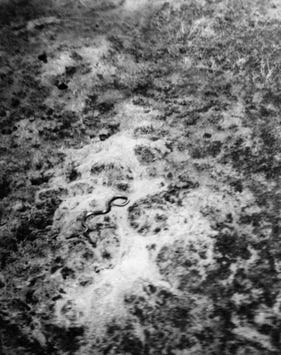
On a more distant note, the story of the Bagradas serpent, and others like it, also reminds me of a more modern tale of a humongous snake. Colonel Remy Van Lierde of Belgian Air Forces claimed to have seen a snake about 50ft long while he was flying over Belgian Congo in a helicopter in 1959. Luckily, there was another person in the helicopter to take a picture. The picture is pretty convincing in my opinion. Maybe not 50 ft but certainly a large snake. I think its one of the more believable cryptozoology theories out there. Or could be all doctored image, idk. There’s an interview with the man himself over on YouTube. Take a look if this sort of thing interest you.
Valete, sodales !
If you like my writing, please subscribe to receive similar posts in the future. If there are any errors on my part, I would be grateful to have them pointed out in the comments. Thank you.
Regulus was afterwards captured by the Carthaginians and sent back to Rome to convince the Senate in favor of a peace treaty or exchange. He, instead, decided to argue forcefully against any such measure. Against the entreaties of many, he then handed himself over to the Carthaginians and was tortured to death. Such is the account of Regulus in many later writers. This popular tale is, for example, the very next anecdote given by Gellius after the one about giant serpent. However, it is not present in Polybius’s account of the war and is of doubtful historicity. ↑
All translations are mine unless otherwise stated. ↑
1 pes = 296 mm = 0.971 ft ↑
The English translation is by I.W. Raymond (1936) that I got from Attalus site. ↑
B.C. Niebuhr in Lectures on the History of Rome (1849). ↑
Histories I.67-68 ↑
Stothers, R. B. (2004). Ancient scientific basis of the “Great Serpent” from historical evidence. Isis, 95(2), 220–238.
The story of the Bagradas serpent is usually covered in books dealing with Graeco-Roman dragons like this one:
Ogden, D. (2021). The dragon in the West: From ancient myth to modern legend. Oxford University Press.
This one more focused on the origins of this story is interesting too :
Horvais, C. (2018). L’expédition d’Atilius Regulus en Afrique (256-255 av. J.-C.). Une remise en contexte. Kentron, (34), 161–192. ↑