Two poems on Rome
by Hildebert of Lavardin
Whether in literature or in general history far more attention is paid to the height of imperial Rome than that of subsequent periods. As for literature, Classical Latin literature generates far more interest than of subsequent periods. The great works of medieval European literature consist, in the main, of works in the vernacular : Beowulf, Poetic Edda, Nibelungenlied, The Song of Roland and so on. Even authors who wrote extensively in Latin, like Dante or Petrarch[1], are more known for their vernacular works.
Medieval Latin then, despite recent scholarship taking steps to the contrary, suffers from an image problem. It is often conflated with Vulgar Latin (which is its own can of worms). The latinitas is often derided; usually with an unfair comparison between the quotidian writers of the Middle Ages with the great masters of the ancient world.
There is, in reality, no shortage of great writers in the ‘middle ages’ even if you judge greatness solely by the narrow criteria of adhering to the norms of golden age Latin. There may be in the dark days of early post-Roman Gaul[2] or Britain, writers whose use of Latin is generally suboptimal but this idea, as applied to all of the Middle Ages over the whole of Latin-speaking lands, is ridiculous. Even for the Early Middle Ages, who can read Bede or Einhard and say that they wrote in ‘bad’ or ‘vulgar’ Latin?
In any case, crusading over the qualities, or the lack thereof, of medieval Latin is neither what I want to do here nor am I a even a sufficiently learned person in medieval literature to do so. I just want to share with the readers my translations - as usual, not particularly good - of two poems by Hildebert of Lavardin, a French Bishop of the early twelfth century.
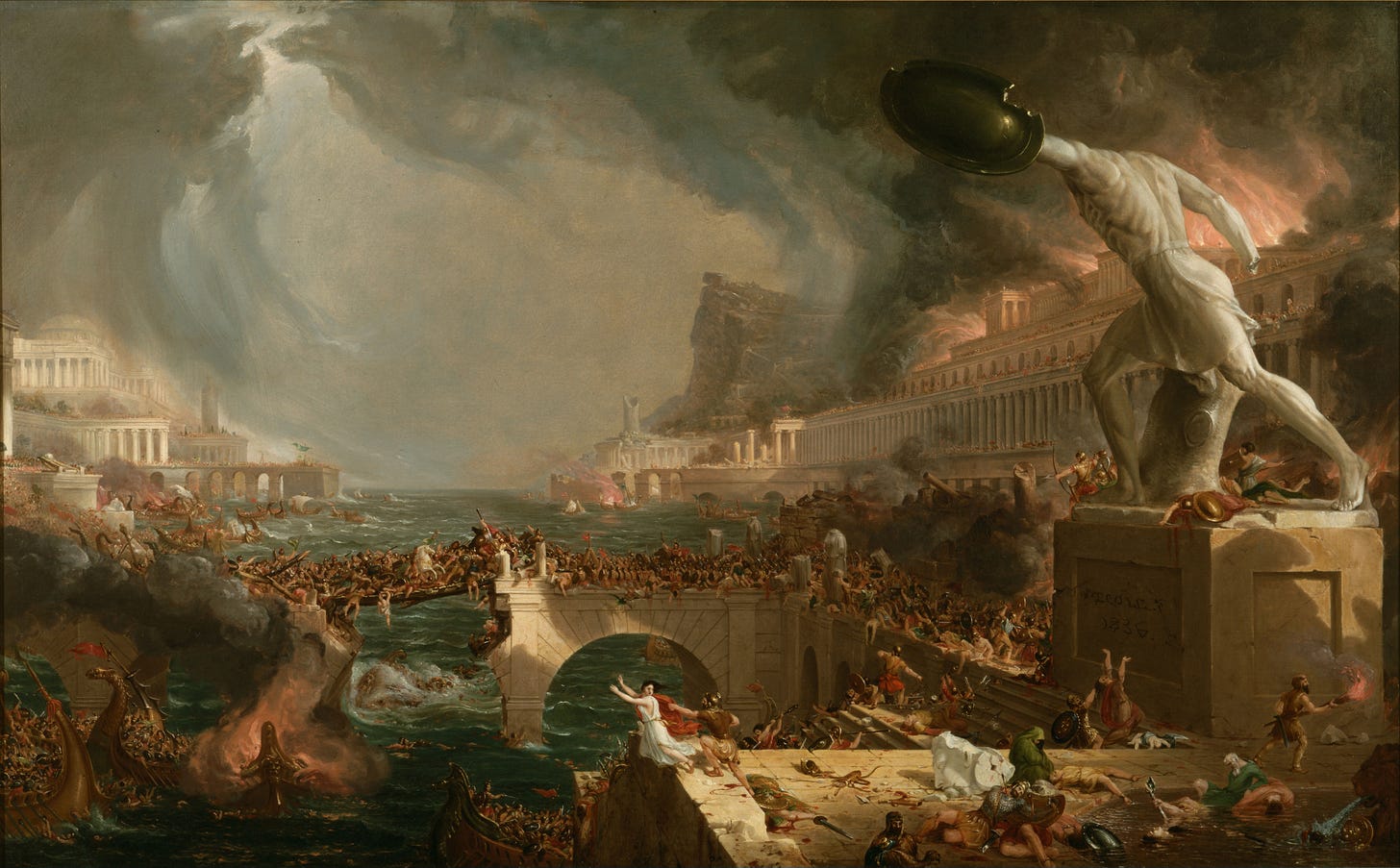
Fig: The Course of Empire by Thomas Cole (1836). This painting does not actually depict the fall of Rome but that of a generic empire.
The first poem is a sort of elegy that contrasts the glories of Rome that once was with her sorry and pitiable state in the times of the author. Except for incidental mentions like “Nature itself couldn’t create gods with faces such as those with which man has created these wonderful statues of the gods.”, there is nothing particularly Christian about it. The second, however, is a sort of reply to the first where Rome herself speaks that even fallen from her erstwhile glory it is better for her to be Christian. In her own words, “Standing, I subdued the earth: fallen, I beat back hell; Standing, I ruled over bodies: downcast, I rule over souls.”
The language is more or less entirely classical. The only clear example of medievalism I could see, except for the orthographic peculiarities like e for ae which I have corrected, is the use of ‘dux’ or duke which I have translated as ‘leader’ but perhaps could have been left as it is.
I like the first one far better than the second, not only because as someone who is not Christian I have no interest in contrasting pre-Christian Rome as some sort of mirror to extol Christian virtues but also because the language itself, in my very subjective opinion of course, feels far better. The second poem feels in fact like a afterthought rejoinder lest the first one seem entirely pagan. This should not, of course, imply in any way that Hildebert was not really Christian and just wrote the second one to cover his bases from the overbearing Church[3]. Hildebert was, as I said earlier, a bishop himself and a great hymn-writer of his age. There is no reason, as far as I can see, to suspect that he wasn’t earnest and strong in his faith and a multitude of reasons to think otherwise.
As for Hildebert himself, his brief page in Wikipedia is more or less informative for our case here:
Hildebert was born of poor parents at Lavardin, near Vendôme, and was intended for the church. He was probably a pupil of Berengar of Tours, and became master (scholasticus) of the school at Le Mans; in 1091 he was made archdeacon and in 1096 or 1097 bishop of Le Mans. He had to face the hostility of a section of his clergy and also of the English king, William II, who captured Le Mans and carried the bishop with him to England for about a year.
Hildebert then (in 1100 or 1103) travelled to Rome and sought permission to resign his bishopric, which Pope Paschal II refused. In 1116 his diocese was thrown into great confusion owing to the preaching of Henry of Lausanne, who was denouncing the higher clergy, especially the bishop. Hildebert compelled him to leave the neighborhood of Le Mans, but the effects of his preaching remained.
It was probably in his journey to Rome to seek permission from the pope that he wrote the poems translated here.
As for their form, both are in Elegiac Couplets. The text presented here is taken from Hildeberti Cenomannensis Episcopi Carmina minora edited by A. Brian Scott (1969) where they are in No. 36 and 38 respectively and both entitled “De Roma” or “On Rome”. The English titles here are my own. As usual, the translation is not in metre.
English Translations
1 - None is your equal, Rome!
None is your equal, Rome, though you are almost entirely
in ruins: broken you show how great you were when whole.
Long age destroyed your arrogance and Caesar’s citadels
lie in the swamp along with the temples of the gods.
That work! that work is in ruins which the fell Araxes
trembled at as it was standing and grieved when it fell;
which the swords of kings, which the senate’s far-seeing
laws, which the gods above made the head of the world;
which Caesar wished more to possess alone through crime
rather than to be a pious companion and father-in-law;
which rose in three ways: subdued enemies with force,
curtailed crimes by laws and bought friends with wealth;
for which, as it was being built, the care of the elders
watched, the host’s kindness, the place, the river helped too.
Either end of the world sent the materials, builders
and money, the place offered itself for the walls.
Leaders emptied their treasures for it all, fate her favors,
the craftsmen all their zeal and the world her riches.
The city has fallen and if I try to say anything at all
that is worthy of her, I shall just say this: Rome was.
Neither the turning of years, nor flames, nor swords
were ever able to efface this glory completely.
So much still stands, so much is in ruins that neither
can one equal the standing, nor restore the ruined.
Collect again expenses, new marbles, the gods’ favor,
let the hands of craftsmen be employed in new works:
still this edifice would neither equal the still standing
walls nor even be able to restore the ruins only.
The cares of men were able to build that great Rome
which the cares of the gods were unable to undo.
Here the gods above gaze awestruck at their own statues
and wish to be equal to those manmade faces. Nature itself
couldn’t create gods with faces such as those with which
man has created these wonderful statues of the gods.
The faces of the deities are still there but are revered now
more for the skill of the sculptors than their own divinity.
O blessed city! would that you didn’t have the lords you do
or that it would be shameful for your lords to lack faith.
2 - Rome’s reply
When manmade idols, when false deities were dear to me,
I rose up high with my armies, people and city-walls.
But as soon as I threw away all idols as well as superstitious
altars and became a servant to only the one true God,
the citadels then yielded, the palaces of the deities fell,
the people became enslaved, the knights degenerated.
I hardly know who I was, hardly remember myself as Rome,
my downfall hardly allows me to remember myself.
These downfalls are better for me than those successes:
I am greater poor than rich, greater fallen than standing.
The sign of the cross gave me more than the eagles, Peter
more than Caesar; the unarmed masses more than all leaders.
Standing, I subdued the earth: fallen, I beat back hell;
standing, I ruled over bodies: downcast, I rule over souls.
Then I ruled over the miserable plebs, now I lord it over
the rulers of hell; then cities, now the sky is my kingdom.
Lest it seem that Caesars were responsible for this  or power,
lest the outer looks of things swept me and mine away:
My power in arms fell, the high glory of the senate is ruined,
The temples have broken down, the theatres are fallen,
The rostra are empty, the edicts are silent, veterans lack
their just rewards, people lack laws and the land farmers.
The once fell knight wants leisure, the once inflexible judge
loves bribes and the once free pleb has to endure his yoke.
All these have fallen lest any citizen place hope in these
and miss the hope as well as the good that the cross gives.
The Cross promises other homes, promises other honours
and gives to its own soldiers a kingdom up there in heaven.
The king serves, free nonetheless, under the cross; he wears
A diadem but is held by law. He fears, yet loves, his orders.
Greedy, he pours out wealth but is rich anyway: he lends out
but guards it correctly for he places it above the stars.
Which Caesar with his sword, which consul with his care,
which orator with his tongue, which war camp with its arms
ever gave so much to me? With their zeal and their laws
I won the earth: but the cross alone gave me heaven.
Latin Originals
1- De Roma
Par tibi, Roma, nihil, cum sis prope tota ruina.
     quam magni fueris integra, fracta doces.
longa tuos fastus aetas destruxit, et arces
    Caesaris et superum templa palude iacent.
ille labor, labor ille ruit, quem dirus Araxes
     et stantem tremuit et cecidisse dolet;
quem gladii regum, quem provida iura senatus,
     quem superi rerum constituere caput;
quem magis optavit cum crimine solus habere
     Caesar, quam socius et pius esse socer.
qui, crescens studiis tribus, hostes, crimen, amicos,
     vi domuit, secuit legibus, emit ope.
in quem, dum fieret, vigilavit cura priorum
     iuvit opus pietas hospitis unda locum.
materiem, fabros, expensas axis uterque
     misit: se muris obtulit ipse locus.
expendere duces thesauros, fata favorem,
     artifces studium, totus et orbis opes.
urbs cecidit de qua si quicquam dicere dignum
     moliar, hoc potero dicere ‘Roma fuit’.
non tamen annorum series, non flamma, nec ensis
     ad plenum potuit hoc abolere decus.
tantum restat adhuc, tantum ruit, ut neque pars stans
     aequari possit, diruta nec refici.
confer opes marmorque novum, superumque favorem
     artificum vigilent in nova facta manus,
non tamen aut fieri par stanti machina muro,
    aut restauri sola ruina potest.
cura hominum potuit tantam componere Romam
   quantam non potuit solvere cura deum.
hic superum formas superi mirantur et ipsi,
     et cupiunt fictis vultibus esse pares.
non potuit natura deos hoc ore creare
     quo miranda deum signa creavit homo.
vultus adest his numinibus, potiusque coluntur
     artificum studio quam deitate sua.
urbs felix, si vel dominis urbs illa careret,
     vel dominis esset turpe carere fide.
2-De Roma
Dum simulacra mihi, dum numina vana placerent,
     militia, populo, moenibis alta fui.
at simul effigies arasque superstitiosas
    deiciens, uni sum famulata Deo,
cesserunt arces, cecidere palatia divum,
     servivit populus, degeneravit eques.
vix scio quae fuerim, vix Romae Roma recordor,
     vix sinit occasus vel meminisse mei.
gratior haec iactura mihi successibus illis:
     maior sum pauper divite, stante iacens.
plus aquilis vexilla crucis, plus Caesare Petrus,
     plus cunctis ducibus vulgus inerme dedit.
stans domui terras, infernum diruta pulso;
     corpora stans, animas fracta iacensque rego.
tunc miserae plebi, modo principibus tenebrarum
     impero: tunc urbes, nunc mea regna polus.
quod ne Caesaribus videar debere vel armis,
     et species rerum meque meosque trahat,
armorum vis illa perit, ruit alta senatus
     gloria, procumbunt templa, theatra iacent,
rostra vacant, edicta silent, sua praemia desunt
     emeritis, populo iura, colonus agris.
durus eques, iudex rigidus, plebs libera quondam,
     quaerit, amat, patitur, otia, lucra, iugum.
ista iacent ne forte meis spem ponat in illis
     civis, et evacuet spemque bonumque crucis.
crux aedes alias, alios promittit honores,
     militibus tribuens regna superna suis.
sub cruce rex servit, sed liber; lege tenetur,
     sed diadema gerens; iussa tremit, sed amat.
fundit avarus opes, sed abundat: foenerat idem,
     sed bene custodit, sed super astra locat.
quis gladio Caesar, quis sollicitudine consul,
     quis rhetor lingua, quae mea castra manu
tanta dedere mihi? studiis et legibus horum
      obtinui terras: crux dedit una polum.
Salvete Sodales!
If you like my writing, please subscribe to receive similar posts in the future. If there are any errors on my part, I would be grateful to have them pointed out in the comments. Thank you.
Though calling Dante or Petrarch medieval might be stretching the definition of ‘medieval’ to its limits, the point stands. ↑
I have been reading on Merovingian Gaul lately and the language of the historical sources, either of Gregory of Tours or of the anonymous chroniclers, is not great, to put it politely. Although I have not read it, the Latin of Gildas in post-Roman Britain supposedly not great either. ↑
I say this because I have heard similar opinions expressed about the Goliards or the Carmina Burana. I don’t think saying so in their case is any more accurate than with Hildebert. ↑