The Wanderer
Translation of an Old English Elegy
I first came to know of the Lord of the Rings through some mobile game whose name I cannot remember now. But it was only around 2018 or 2019 that I read the Hobbit and the Lord of the Rings and liked them greatly. There is in the LoTR, as in much of Tolkien’s Legendarium, a feeling of profound sadness that is hard to point down to specific events but colours the mind of those who read it. The movies, ‘action movie for young people 15 to 25’ as Christopher Tolkien puts it, are far removed from this feeling, being focused on action and violence to a degree Tolkien would probably have found distasteful, but they aren’t devoid of it either.
Tolkien Studies is a pretty blooming field nowadays and I’m sure someone has put in clear and comprehensible terms[1] what I can only point vaguely at. ‘Melancholy’, in my opinion, is a nice word for this. Melancholy not for this thing or that but of life itself.
After Tolkien I wanted to read something that was similar. I liked this melancholy feeling and sought more of it but the few fantasy books I tried seemed all lacking in this respect. Frustrated with this I tried to go for things that had inspired Tolkien himself in the first place. Here at last, in the strange world of medieval north, was what I was looking for. Old English and Old Norse literature was what I wanted, even if I didn’t know it.
I have since been reading, in translations of course, little by little things of interest in Old English, Norse and related languages. A facet of Norse worldview during and around the Viking Age is what I’ve heard described as Positive Fatalism: the belief that things will go badly, defeat ultimately comes even after victories uncountable but the response to such events is not cowardice or pessimism but a noble bearing in facing it. A valiant last stand, if you will, against forces unimaginably larger but the courage to face it boldly. Norse Gods with Odin at their head are, to take a well-known example, certain of their upcoming defeat at the hands of their enemies at Ragnarök but this doesn’t stop Odin from amassing heroes and warriors (einherjar) in Valhalla to meet his fate. Never is it made clear in the medieval texts, though this is the impression that modern readers often come away with, that Odin hopes to prevent Ragnarök or even to win it. He simply faces the challenge boldly knowing full well that defeat is certain and fate inexorable because that is just the right and noble thing to do.
Over the second half of the first millennium AD, northern Europe was slowly but surely Christianized. The Anglo-Saxon were Christianized earlier and the Norse only around the turn of the millennium. The resulting Christianity practiced by these northern folk, it seems, combined this ‘positive fatalism’ with the hope and compassion of a distant and eternal but compassionate God to produce, in their literature at least, a strangely beautiful melancholy tampered by hope of the eternal hereafter that Tolkien sought to emulate, quite successfully I think, in his own works. Bede’s Sparrow is a nice illustration of what I’m trying to get at.
The following is my translation of an Old English poem which is usually entitled ‘The Wanderer’ by modern editors. It is a sort of elegy by a lone, wretched exile, recounting the difference between his current miseries and the blissful days that have gone by never to return. It is a beautiful poem, full of the aforementioned melancholy and has been translated many, many times into modern English. It is probably the most popular Old English poem after Beowulf. My translation presented here just because I like it and not because I hope to better any existing translations. Indeed, it is certainly worse in many respects than the many published translations by people who are far more talented and far more knowledgeable than me. Readers with a knowledge of the original language would probably be able to find faults in every line. Be that as it may, if even a single person is inspired to search for other, better, translations or even better to learn the original itself, I would be contended.
As for the form and content of the translation, it is not in verse, in which I’m incapable of producing anything decent in English, but in chopped up and formatted prose. I have sometimes translated the Old English word with corresponding descendant word in Modern English. Modern English ‘midgard’ (though this comes from Old Norse) for Old English middanġeard ‘middle-enclosure = Earth’ is an example, ‘forth-way’ for Old English forþweg is another. In general, however, the meaning of these should be sufficiently clear.
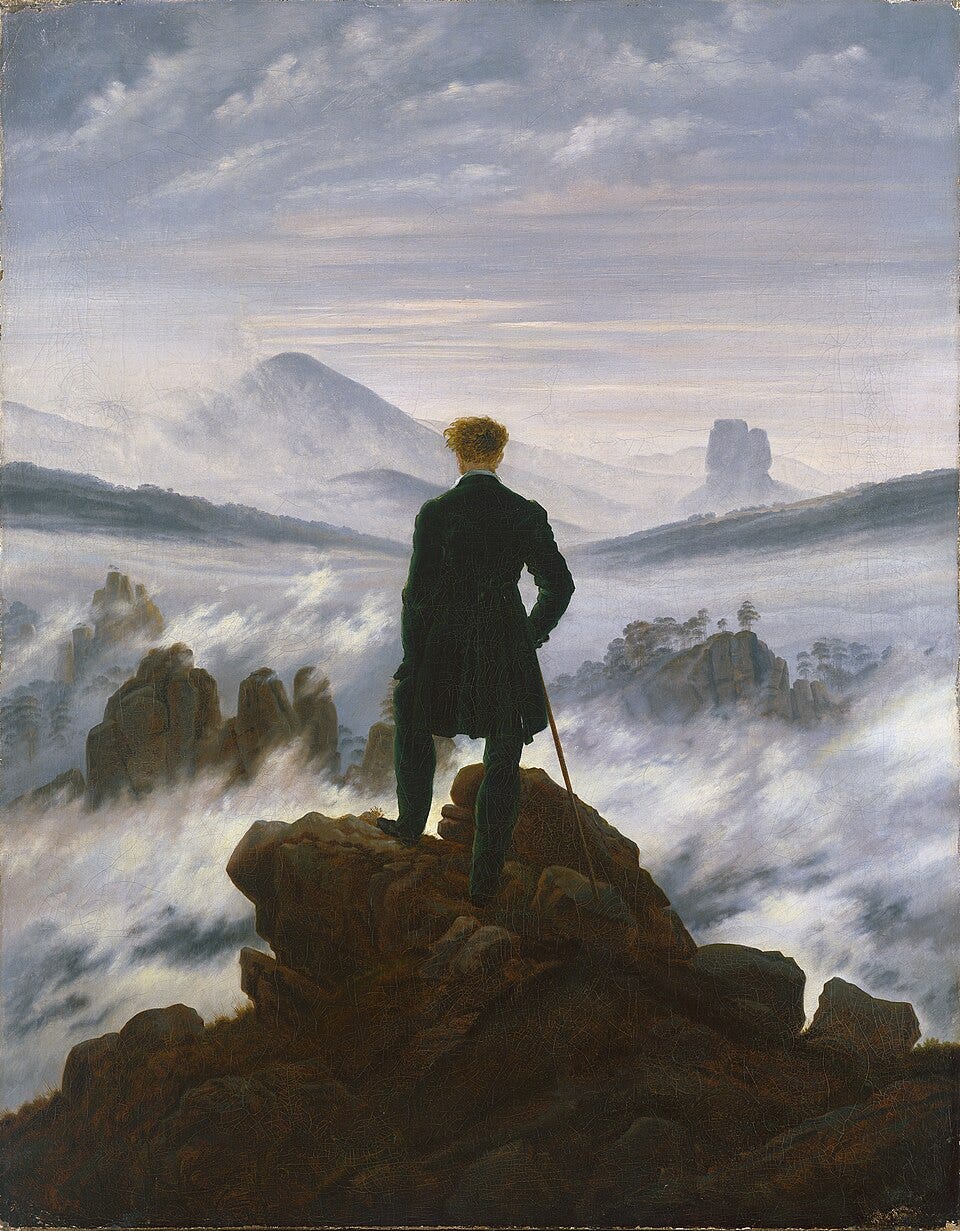
Fig: Wanderer above the Sea of Fog (1818) by Caspar David Friedrich.
The Poem
Often the solitary man         waits for mercy for himself,
grace of the Lord,         though at heart sorrowful,
over the watery ways         long he is compelled
to stir with his hands         over frost-cold sea,
to wade through exile-paths.         Wyrd is fully fixed.
So speaks the earth-stepper,         mindful of troubles,
of cruel slaughters         and the fall of dear kin:
Often am I forced alone         at the break of day
to speak of my sorrows.         There is none alive now
to whom about my heart         I can ever dare
to speak clearly.         I know for certain
that it is for an earl         a noble habit
that he keep his life-enclosure         bound fast
and hold his hoard-chamber         think though as he may.
Neither can a weary mind         withstand against wyrd,
nor can troubled thoughts        offer him any help.
So, those eager for doom         often bind fast
in their breast-chamber         all their dreariness;
So then should I          do with mine,
often poor and sorrowful,         separated from my land,
far from free kinsmen,         bind it with fetters,
after I had of old         had my gold-friend
covered in earth’s darkness         and thence dejected
went out winter-sorrowful         over the rolling waves
searching, hall-dreary,         a giver of riches,
where far or near         I might find one
who in a mead-hall         may understand my mind,
want to console me,         a friendless man,
and entertain me with joys.         He who has suffered knows
how cruel is it         to have sorrow as a companion
to a man who has few         of his dear confidants.
Exile holds him,         not twisted gold;
frozen life-enclosure,         not the joys of earth.
He remembers his hall-fellows         and the giving of riches,
how in his youth         his gold-friend
entertained him in feasts.         All joy has perished.
Thus, he who has been forced         to forsake for long
the commanding words         of his dear-lord understands
when sorrow and sleep,         both at the same time,
have a poor solitary man         in their bounds:
It appears in his mind         that he kisses his own lord,
embraces and kisses him         and lays on his knees
hands and head,         as he had often before
in days gone by         enjoyed the gift-seat.
But when he wakes up again         the friendless man
sees before him         the wine-dark waves,
sea-birds bathing,         spreading their feathers,
falling frost and snow,         mingled with hail.
Then become heavier         the wounds of his heart,
sore to see his beloved;         sorrow is renewed.
When he, remembering his kin,         passes his mind around,
greets with great joy,         searches eagerly for
men who were his hall-mates,        they all swim away.
The cries of flying birds         don’t bring down many
sounds known to him.         Care is renewed then
for one who is forced to send         more often than not
over the freezing waves         his weary heart.
So, I cannot think why         around this world
the thoughts in my mind         do not grow dark
when I think all over         about the lives of earls:
how all of a sudden         they gave up their hall-floors,
brave and noble kinsmen.         So, this midgard
day after day         falls and perishes.
So no man can be wise         before he has spent
his share of days in world-kingdom.        A wise man should be patient;
should neither be hot of heart         nor be hasty of speech,
should neither be weak         nor be reckless,
nor be quick to boasts         before he knows for certain.
A man should wait         before he speaks boastfully
until he, stout-hearted,         knows it for certain
where his boastful words         are leading him.
A clever man should understand         how spiritual is it
that all the wealth of this world         become waste at last
as now in various ways         all over this midgard
walls still stand         blasted by winds,
covered with frosts,         though houses be snow-swept.
The wine-hall decays,         its lord lies down,
deprived of joy,         all the proud retainers
fall about the wall.         Some war snatches away
and bears to the forth-way;         birds bore some away
over the deep sea;         the grey wolf
dealt death to some;         a sad-faced earl
hid some away         in earthen caves.
So the creator of men          destroys this midgard
until the old works of ents         stand all empty
without any of the noise         of former city-dwellers.
About this foundation         he who has thought wisely
and thinks deeply         on this dark life,
old and wise in spirit,         and who remembers often
many great slaughters         speaks these words:
Where has the young man gone?
Where has the horse gone?
Where the giver of riches?
Where have feast-seats gone?
Where are the joys of the hall?
O the bright cup!         O the mail-clad warrior!
O the valour of kings!         How that time has passed,
darkened under cover of night         as if it never was.
Still stands at last now         for that dear host
a wondrously high hall         decorated with worms.
An array of spears         snatched the earls away,
weapons greedy for slaughter -         wyrd is the greatest - ,
and the stony cliffs         are beaten by storms,
the falling frost         binds the earth,
the tumult of winter         when the darkness comes,
the night-shadow darkens,         sends from the north
fierce hailstorms         wrathful against men.
Everything is full of hardships         in this earth-kingdom;
the creation of wyrd         overturns world under heaven.
Here wealth is temporary;         here friend is temporary;
here a man is temporary;         here a kin is temporary.
All this foundation of earth         comes down to nothing.
So spoke the wise man in his mind,         and set himself apart thinking.
He is good who holds true to himself         and shall never speak his anger too soon,
speak of the thoughts in his breast         until he knows the solution beforehand
to do things valourously as an earl.         Well is it to him who seeks mercy,
consolation from the Father in heaven,         for only there does permanence exist for us all.
Wesaþ ġē hāle!
If you like my writing, please subscribe to receive similar posts in the future. If there are any errors on my part, I would be grateful to have them pointed out in the comments. Thank you.
The Tower and the Ruin: J.R.R. Tolkien's Creation (2024) by Michael D.C. Drout sort of does this, though its main thesis lies elsewhere. ↑