The True History™ of the Trojan War
An eyewitness account.
Christopher Nolan’s upcoming Odyssey movie has recently got many people talking about how the Homeric heroes are supposed to look like. I’ve got nothing to add to any side in that conversation. I would, however, like to draw the readers’ attention to the precise physical descriptions of many heroes of the Trojan War in an ancient source:[1]
Dares the Phrygian, who wrote this history, says that he did military service until the capture of Troy and saw the people listed below either during times of truce or while he was fighting. As for Castor and Pollux, he learned from the Trojans what they were like and how they looked: they were twins, blond haired, large eyed, fair complexioned, and well-built with trim bodies.
Helen resembled Castor and Pollux. She was beautiful, ingenuous, and charming. Her legs were the best; her mouth the cutest. There was a beauty-mark between her eyebrows.
Priam, the king of the Trojans, had a handsome face and a pleasant voice. He was large and swarthy.
Hector spoke with a slight lisp. His complexion was fair, his hair curly. His eyes would blink attractively. His movements were swift. His face, with its beard, was noble. He was handsome, fierce, and high-spirited, merciful to the citizens, and deserving of love.
Deiphobus and Helenus both looked like their father, but their characters were not alike. Deiphobus was the man of forceful action; Helenus was the gentle, learned prophet.
Troilus, a large and handsome boy, was strong for his age, brave, and eager for glory.
Alexander was fair, tall, and brave. His eyes were very beautiful, his hair soft and blond, his mouth charming, and his voice pleasant. He was swift, and eager to take command.
Aeneas was auburn-haired, stocky, eloquent, courteous, prudent, pious, and charming. His eyes were black and twinkling.
Antenor was tall, graceful, swift, crafty, and cautious.
Hecuba was beautiful, her figure large, her complexion dark. She thought like a man and was pious and just.
Andromache was bright-eyed and fair, with a tall and beautiful body. She was modest, wise, chaste, and charming.
Cassandra was of moderate stature, round-mouthed, and auburn-haired. Her eyes flashed. She knew the future.
Polyxena was fair, tall, and beautiful. Her neck was slender, her eyes lovely, her hair blond and long, her body well-proportioned, her fingers tapering, her legs straight, and her feet the best. Surpassing all the others in beauty, she remained a completely ingenuous and kind-hearted woman.
Agamemnon was blond, large, and powerful. He was eloquent, wise, and noble, a man richly endowed.
Menelaus was of moderate stature, auburn-haired, and handsome. He had a pleasing personality.
Achilles had a large chest, a fine mouth, and powerfully formed arms and legs. His head was covered with long wavy chestnut-colored hair. Though mild in manner, he was very fierce in battle. His face showed the joy of a man richly endowed.
Patroclus was handsome and powerfully built. His eyes were gray. He was modest, dependable, wise, a man richly endowed.
Ajax, the son of Oileus, was stocky, powerfully built, swarthy, a pleasant person, and brave.
Ajax, the son of Telamon, was powerful. His voice was clear, his hair black and curly. He was perfectly single-minded and unrelenting in the onslaught of battle.
Ulysses was tough, crafty, cheerful, of medium height, eloquent, and wise.
Diomedes was stocky, brave, dignified, and austere. No one was fiercer in battle. He was loud at the war-cry, hot-tempered, impatient, and daring.
Nestor was large, broad and fair. His nose was long and hooked. He was a wise adviser.
Protesilaus was fair-skinned, and dignified. He was swift, self-confident, even rash.
Neoptolemus was large, robust, and easily irritated. He lisped slightly, and was good-looking, with hooked nose, round eyes, and shaggy eyebrows.
Palamedes was tall and slender, wise, magnanimous, and charming.
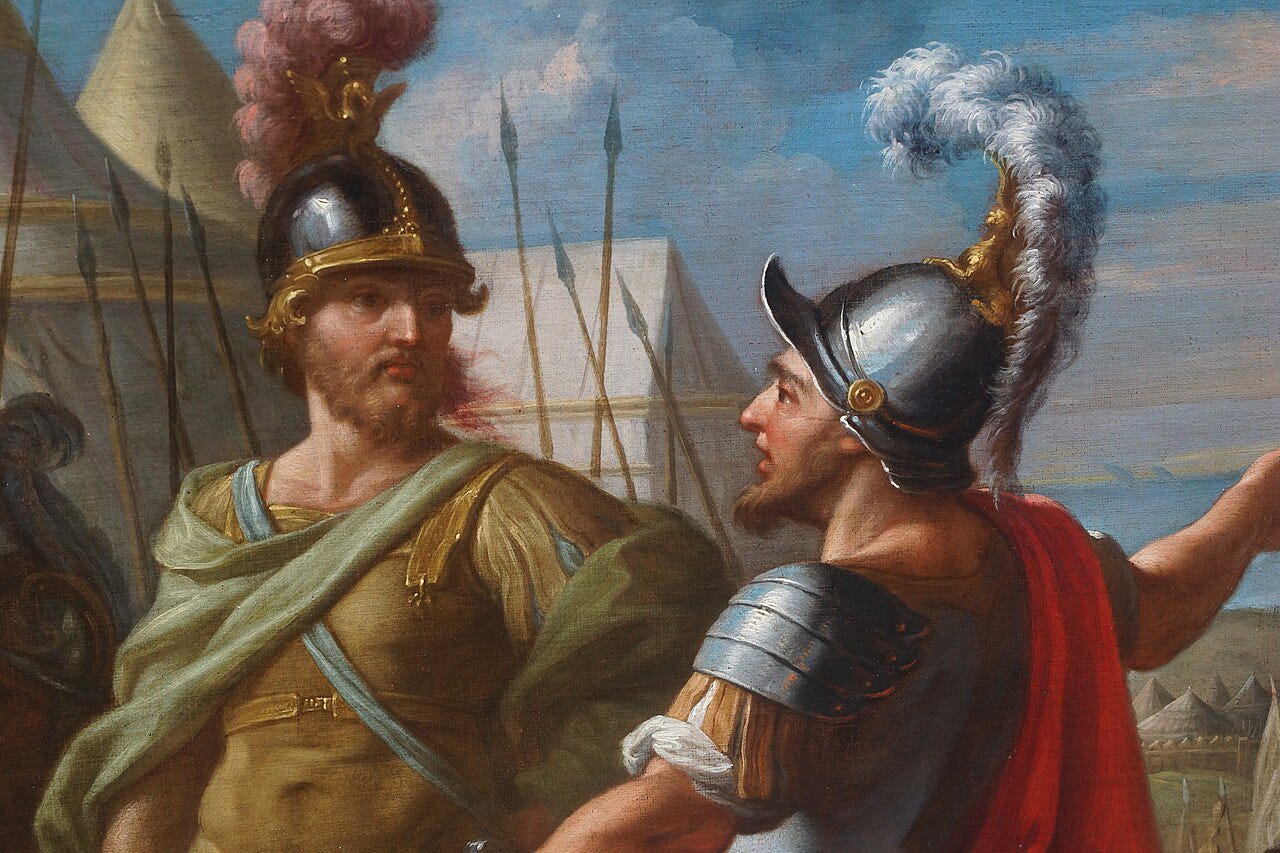
The argument between Ajax and Odysseus over Achilles' armour by Agostino Masucci.
What I just quoted is a description of the physical features of the major heroes of the Trojan War from the de excidio troiae historia (History of the Fall of Troy) by Dares the Phrygian, who was a Trojan soldier and eye-witness of the whole war. He wrote a history of the war which was translated into Latin by the first century BC historian Cornelius Nepos. But, you might say, Trojan War wasn’t actually historical. My sweet summer child, of course you think so after reading the hack Homer’s epics. Did you know that Homer was posthumously indicted in the Athenian court for making shit up? Who would you believe, Dares, who was contemporary, or Homer, who lived centuries afterwards and was apparently blind? Why has this information been suppressed, you ask? Well, I can’t unravel the whole thing here but its got something to do with Big-Roman propaganda. Aeneas, you see, wasn’t who Roman propaganda makes him out to be..
The True History of the Trojan War
To be more serious, what I said above isn’t all in jest. The text called De excidio troiae historia does exist. It does claim to be a translation by the Roman historian Cornelius Nepos from the original (Greek?) text authored by Dares the Phrygian. It is an euhemeristic account of the Trojan War which means that all the explanations of the actions are strictly human. All the divine actions that make the Homeric epics what they are have been stripped away. The heroic spirit is all gone. The best I can describe it is: imagine the ancient Greek equivalent of a smug atheist redditer, euphoric not by some phony gods’ blessing but by his own intelligence, deconstructing the Trojan War in absolutely atrocious prose. The parallels aren’t exactly strict but you get the point.
Of course, nowadays even people who haven’t studied the text in detail can tell why the text is probably not authentic. This has been clear to historians for some centuries now. But it wasn’t always the case. For much of the medieval era, people, even (or perhaps especially) well-read scholars, did believe that it was accurate. As the knowledge of Greek language faded in the west, there were only a few Latin sources for the knowledge of the Trojan War. There was, of course, the Aeneid which was second in popularity only to the Bible. There was also an ancient epitome of the Iliad in around 1000 lines by a certain Publius Italicus. The situation could sometimes get so confused that this short poem, which most modern critics judge very harshly, was thought to be the Iliad by Homer himself. Isidore of Seville’s Etymologiae puts it succinctly in the History Section of his encyclopedia:
Historiam autem apud nos primus Moyses de initio mundi conscripsit. Apud gentiles vero primus Dares Phrygius de Graecis et Troianis historiam edidit, quam in foliis palmarum ab eo conscriptam esse ferunt.
Among us Moses wrote the first history from the beginning of the world. Among the pagans, Dares the Phrygian wrote a history about the [war between] the Greeks and the Trojans which he is said to have written in palm leaves.
Dares, it turns out, was the first historian![2]
Besides these poetic texts, they also had prose accounts of the Trojan War. Of these, there were two major ones: De excidio Troiae Historia by Dares the Phrygian and Ephemeris belli Trojani (Journal of the Trojan War) by Dictys of Crete.
Both of these share a lot of similarities. Both present a rational, humanistic narrative of the Trojan war and remove all supernatural events. Both survive only in a Latin translation though both claim, and likely were, translated from earlier Greek originals. Both claim to have been written by contemporaries of the war: Dares the Phrygian on the Trojan side and Dictys of Crete on the Greek side.
Though the text of Dares is late, he is actually a character in early Greek myths. In fact, he occurs in the Iliad itself.
Ἦν δέ τις ἐν Τρώεσσι Δάρης ἀφνειὸς ἀμύμων
ἱρεὺς Ἡφαίστοιο·
Iliad V.9-10
There was a certain rich and noble priest of Hephaestus named Dares among the Trojans.
As I said earlier, for much of the medieval Latin Europe, the narratives of Dares and Dictys were the major sources for their knowledge of the Trojan war story. There were multiple adaptations, both in Latin and in vernacular languages. The story of Troilus and Cressida, for example, for which we have versions by such writers as Boccaccio, Chaucer and Shakespeare, was based in large part on these writers. Snorri Sturlusson’s Prose Edda, which tries to present the Norse Gods as ancient Trojan Heroes, was probably based indirectly on them. There’s even an Old Norse translation of the Dares’ work called Trójumanna Saga (Saga of the Men of Troy). It’s an interesting work in its own right. Imagine the Trojan War but everyone’s a viking.
Summary
The Excidio starts with a prefatory letter by Cornelius Nepos addressed to Sallust saying that Nepos found this work when he was in Athens and has translated as simply and literally as he could. The original, he says, was written by a certain Dares the Phrygian who lived during the time of the Trojan war and was a participant from the Trojan side.
Pelias, the Peloponnesian king, is threatened by his nephew Jason and orders him to get the famous golden fleece from Colchis. Heroes arrive from all Greece and a guy named Argus builds a ship for the expedition. They are called Argonauts. On the way to Colchis, they land on the port Simeon in Phrygia. When King Laomedon immediately threatens them to get off his land. The Greeks take this badly but get on with their mission.
After the golden fleece is won, Hercules remembers the mistreatment by Laomedon and assembles a Greek army to go teach the Phrygians [i.e Trojans] a lesson. They make for Troy, kill Laomedon and plunder Troy. One of the Greek leaders, Telamon, abducts Laomedon’s daughter Hesiona to be his wife. Priam, Laomedon’s son, survives and plans for revenge. Alexander (aka Paris) reveals in the assembly that he had a dream where he recounts the whole Judgement of Paris scene. Probably the only remotely clever thing in the whole narrative. Priam sends Antenor and Aeneas to ask all the Greek leaders to give Hesiona back. Nobody does so but further insult Antenor in turn.
When Antenor returns and recounts what happened, Priam sends Paris in turn to do the same thing where Paris brings back Helen, who was not unwilling, with him back to Troy as tit-for-tat measure for the abduction of Hesiona. Greeks gather all their men and make for war. They all meets in Athens and decide to perform a sacrifice before starting out. Achilles is sent to Delphi as their representative to perform a sacrifice where he meets the soothsayer Calchas, son of Thestor, a Trojan who had come thither as well. Calchas turns sides without any apparent reason and joins the Greeks.
The Greeks reach Troy and first send Odysseus and Diomedes as messengers to ask Helen back but are rejected. The war start. The details of the battle are extremely repetitive. The fighting starts, thousands of soldiers and some named commanders die and one side begs for a ceasefire. There are so many goddamn ceasefires its actually hilarious. Out of total 10 year war, 7 years, 3 months and 20 days of total ceasefire are mentioned.
The extremely repetitive battle scenes continue until all major Trojan commanders except Aeneas, Antenor and Amphimachus, Priam’s young son. To the help of Trojans, Amazons show up and turn Greeks back to their ship until the Greeks go back to Greece and bring dead Achilles’ alive son to kick their asses. At last Trojans are in dire need. Priam convenes a council where Aeneas and Antenor argue in favor of making peace with the Greeks. Priam and his young son Amphimachus just insult the both of them as they were the envoys who first travelled to Greece and had at first encouraged war in the first place. Trojans under Amphimachus prepare for a last stand. Aeneas and Antenor are now suspect in the King’s eyes and fear whether Priam is about to have them executed. So, they send their men at night to Agamemnon promising to open the city gates if the safety of their own and their followers is guaranteed. Agamemnon makes sure there’s no double dealing here and then accepts it. Aeneas and Antenor open the port’s gates to Greek’s ship- which has a carved horse at its head- and the city falls.
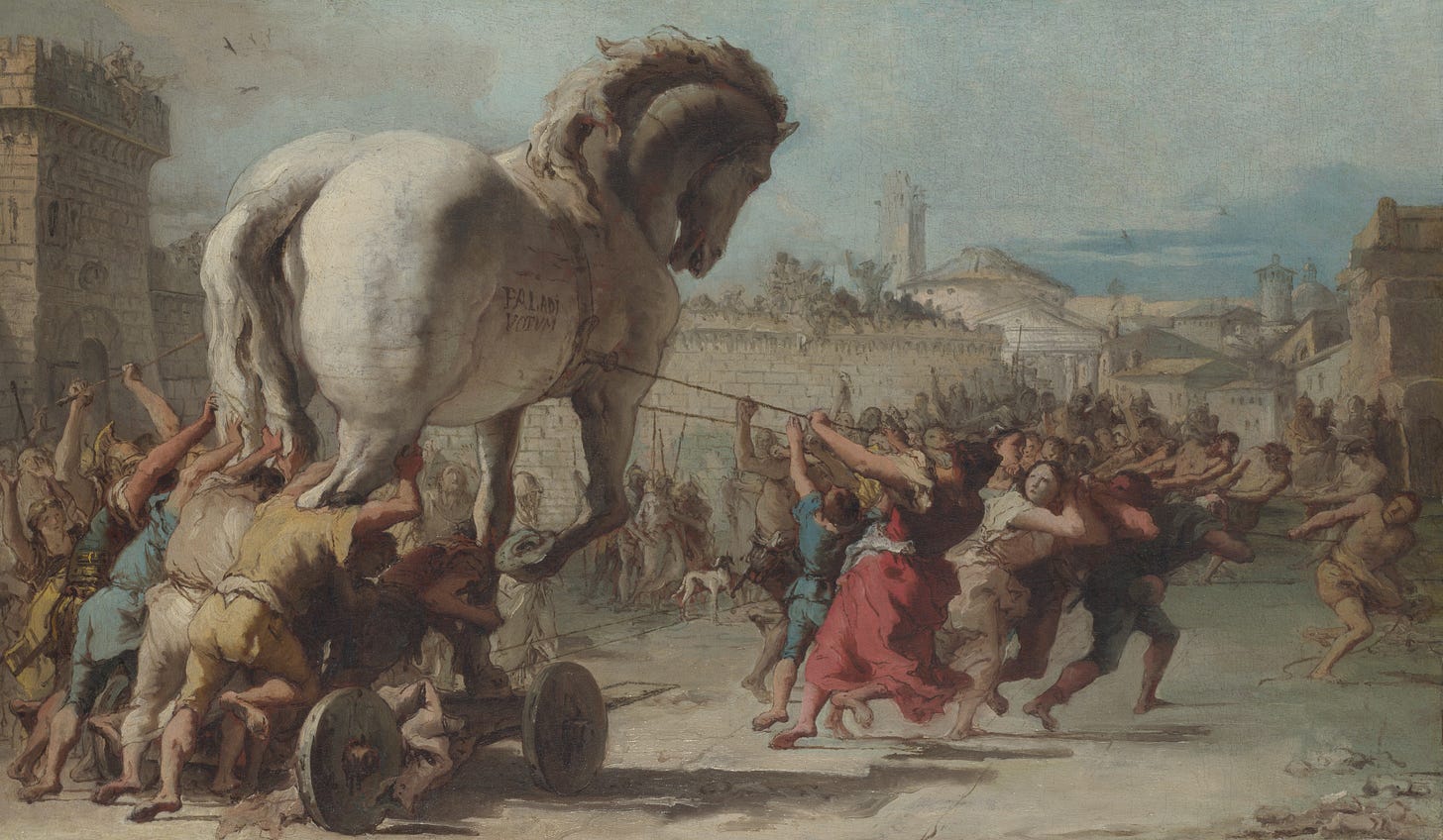
Fig: The Procession of the Trojan Horse in Troy by Giovanni Domenico Tiepolo 1760s.
Aeneas and Antenor aren’t harmed by the Greeks but Aeneas turns out to be hiding Polyxena. So, he is ordered to leave Troy and sail away. He goes with 21 ships to the west. Antenor and his followers, our author Dares among them, remain in Troy.
Total duration: 10 years, 6 months, 20 days.
Total deaths: 866,000 Greeks and 676,000 Trojans (until the city is betrayed).
On Achilles, Agamemnon and Heroism
Even from my bare-bones summary, it should be clear that the general turn of events is very different from Homeric epics. The most important difference, it seems to me, is the absence of the heroic mood. The aristocratic, heroic sentiment of the Iliad is entirely lacking. It reminds me nothing as much as a stray remark by R.W. Chambers in his Widsith: a study in Old English heroic legend (1912):
The Roman or Greek is separated from his heroic age by too many centuries. Court intrigues, theological councils, miracles wrought by the corpses of saints, are of more interest to him.
Whatever the truth of this statement in general, Excidio, exemplifies this down to a letter. Though we’re repeatedly told that so and so fought valorously, the actions seriously belie such claims. The whole work breathes of a sort of civilized, or perhaps domesticated, existence that is deeply foreign to the actual heroes of Homer.
I’ll illustrate this by two episodes: the Coup against Agamemnon and the Death of Achilles.
All the Greeks, as I said in the summary, gather first at Athens and then make for Troy. One of the Greek heroes, Palamedes, misses this meeting and comes to Troy only after the war has already started. Once things start going roughly for the Greeks. Palamedes demands in council that as he wasn’t in the council when Agamemnon was chosen as the leader, and as he is obviously a better leader, he should be elected the leader. Agamemnon meekly accepts. When Agamemnon is sent as an envoy to the sons of Theseus in Mysia for maintaining supply lines, the sons of Theseus are furious that this Palamedes has usurped Agamemnon’s role. Agamemnon, far from being angry, is chill with the situation and replies that all took place according to his own wishes.
Palamedes Agamemnonem legatum mittit ad Thesidas: Demophoontem et Athamantem, quos legatos Agamemnon praefecerat, ut commeatus compararent, et frumentum de Mysia a Telepho acceptum supportarent. Ut eo venit, seditionem Palamedis narrat. Illi moleste ferunt. Agamemnon dicit se moleste non ferre, sua voluntate id factum esse. Interea Palamedes naves comparandas curat, castra munit, turribus circumdat.
Palamedes sends Agamemnon as envoy to the sons of Theseus, Demophon and Athamans, whom Agamemnon had placed in charge of the supply lines and handling provisions brought from Mysia where Telephus was sending them from. They take it ill. Agamemnon says that he doesn’t bear it ill and that it had happened according to his own wishes. Meanwhile, Palamedes sees to it that the ships are constructed, the camps fortified and surrounded with towers.
I cannot imagine anything more unheroic and un-homeric than an usurped leader saying he’s okay with happened. If you know anything about Homer’s Agamemnon, this is the exact opposite characterization. It’s like taking a tiger and making it a vegetarian. The Iliad starts because a petty Agamemnon cannot bear that he is deprived of his sex-slave even if it is to stop a plague and takes Achilles’ sex-slave away. Agamemnon is the leader of the Greek host because he leads the greatest number of ships even without counting his brother’s forces. He is the leader because the whole expedition is his to begin with. He is proud and vain but he is, like all heroes, so in search for kleos. Unlike more modern depictions which often contrast him as sly and cunning against a heroic Achilles, Homeric Agamemnon is anything but cowardly. He is heroic and he is proud to be heroic. He is the King of Men (ἄναξ ἀνδρῶν) placed over people by Zeus with supreme power over them.
To me, a meek Agamemnon chickening in council as he gets coup-ed is no Agamemnon at all.
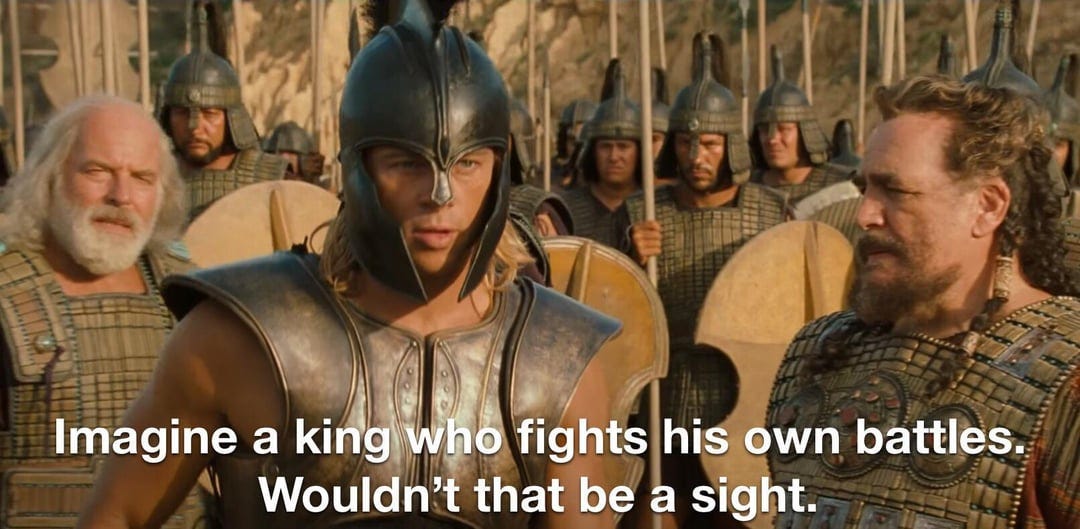
No, it wouldn’t. Ancient and medieval kings regularly fought in their battles. That’s the primary jobs of kings afterall.
The death of Achilles doesn’t occur in the Iliad (except as prophesies) but from early myths we know that Achilles is doomed to lead a short, glorious life and die. He dies of an arrowshot outside the gates of Troy. In Excidio, it’s far different. During one of the ceasefires when Palamedes is the supreme leader, Priam and his family go out to the tomb of Hector at his death anniversary. Achilles somehow happens to be there, sees Priam’s daughter Polyxena and immediately falls in love with her. He sends a message to Hecuba that if Polyxena is given to him in marriage, he will stop fighting for the Greeks and go away. As other heroes aren’t happy being led by Palamedes either, he’ll persuade them to defect too. Hecuba discusses with Priam and replies that they will only give Polyxena in marriage if the war is stopped immediately and restitutions are made to the Trojans. Achilles, of course, cannot promise this but as he is not happy being led by Palamedes instead of Agamemnon, he will not fight anyway. When he’s persuaded to fight, he in turn says:
Achilles vulgo queritur, unius mulieris Helenae causa totam Graeciam et Europam advocatam esse, tanto tempore tot millia hominum periisse; tot pericula adiri; libertatem in ancipiti esse: unde fieri pacem debere, exercitus recedere.
Achilles says to the host that for a single woman, Helen, all of Greece and Europe was brought out, so many thousands of men had fallen, so much troubles had been experienced that even their freedom was at stake. So, they should make peace [with the Trojans] and go back with the army.
As there is neither Chryseis nor the plague in Dares’ version, his promise to Hecuba is introduced to explain why he refuses to fight for a time. There is no heroic death either. Paris tricks him by promising to marry him to Polyxena and when he enters through a gate, strikes him with arrows. His body is saved at the last moment from being fed to vultures.
Such un-heroic changes abound. Of course, many of these aren’t actually original but had previous existence but the cumulative effect is that the whole thing, rather than a more ‘rational’ account as the author probably intended, sounds like a bad parody.
Adieu
The ‘rationalizations’ in Excidio are stupid, the language is torturous and the overall narrative shoddy. Modern scholars do not, for obvious reasons, think very highly about it. The text of Dictys of Crete which I mentioned earlier is more or less the same though it is longer and its language a bit more readable. Anyway, I have a strange fondness for these sort of works.
Modern adaptations of Trojan war story often try to leave out the supernatural elements which leads to the whole thing being rather odd - neither the ‘modernized’ narrative comes out fully believable as the plot points come off as forced nor is the essence of Homer preserved. There are often criticisms in such cases of ‘modern’ writers and producers who ‘butcher’ the original, that the people from bourgeoisie class who decide the limits of good taste are not only uninterested in heroic values but actually strongly against it. I don’t think that all of this criticism is invalid, but as the example of Dares’ Excidio shows, either the ancient Greeks or Romans were equally as ‘modern’ in this regard or contemporary artists have an ancient pedigree to draw upon.
Χαίρετε φίλοι
If you like my writing, please subscribe to receive similar posts in the future. If there are any errors on my part, I would be grateful to have them pointed out in the comments. Thank you.
Translation from The Trojan War. The Chronicles of Dictys of Crete and Dares the Phrygian. Translated by R. M. Frazer (Jr.). Indiana University Press. 1966. ↑
If you want an in-depth look at Dares and the reception of his work, I’d recommend The First Pagan Historian: The Fortunes of a Fraud from Antiquity to the Enlightenment (2020) by Frederick Clark. ↑