The King & the God (H₃rḗḱs dei̯wós-kwe)
The complete tale
Proto-Indo-European (PIE), or sometimes just Indo-European (IE), is the reconstructed ancestor language of many present-day languages ranging from (as the name says) India to Europe and many places between them. It was likely spoken some five thousand years ago in the steppes of eastern Europe around the black sea by peoples associated with the Yamnaya culture. It is a reconstructed language - meaning that no actual piece of literature in this hypothetical language is known and all its features are reconstructed by linguists on the basis of the daughter languages that are attested millennia afterwards.
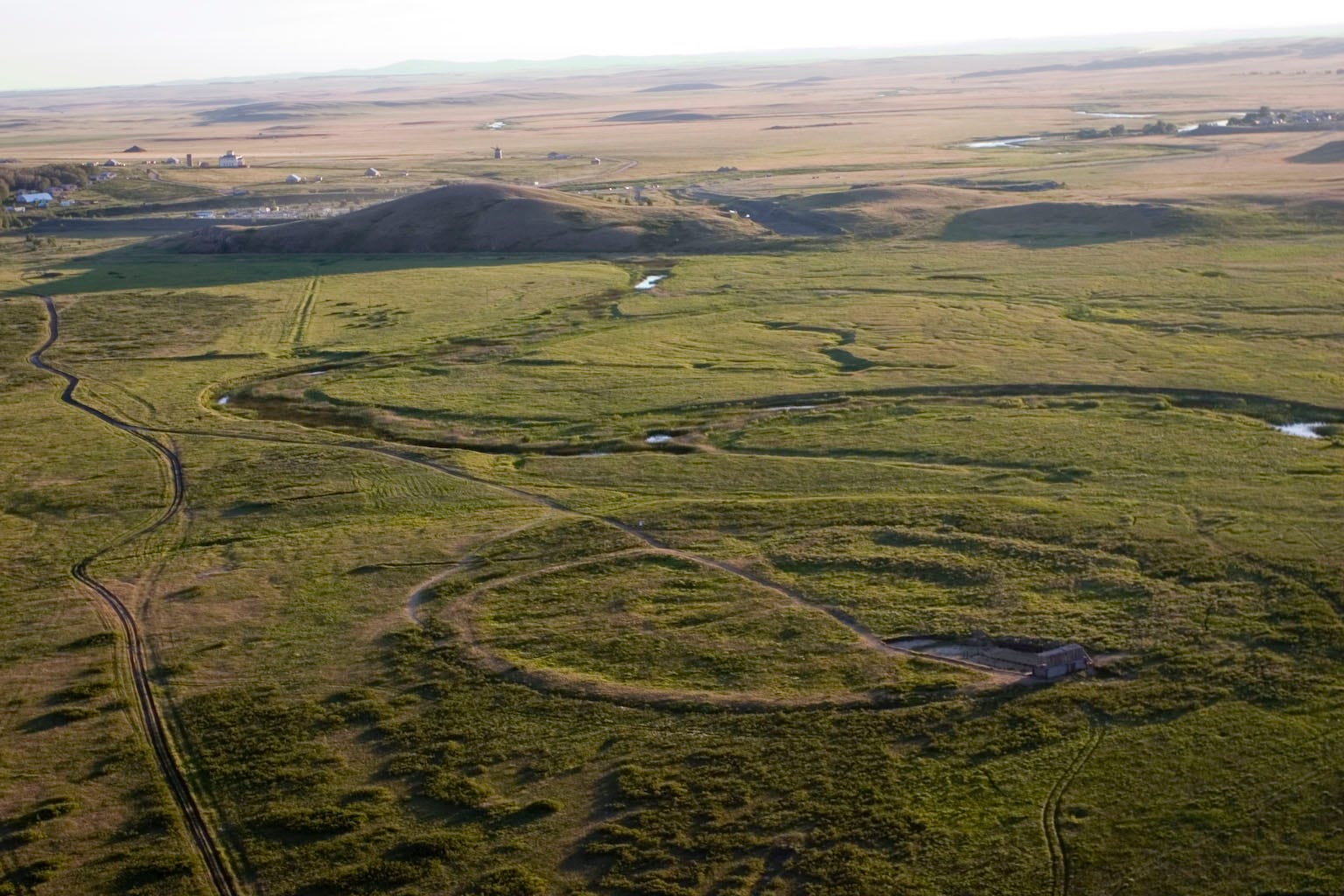
Fig: Archaeological remains of a fortified centre in Arkaim, Russia. This archaeological site belongs, properly speaking, not to the Indo-Europeans but the Indo-Iranians. Looking at these plains, one does get a sense why Indo-Europeans called Earth ‘the broad one’ (*Pl̥th₂éwih₂")
It might seem that reconstructing a language that has no written records based on languages that are attested thousands of years afterwards would be simply impossible but with the help of black magic that is modern historical linguistics, linguists have reconstructed not only a general picture of the language itself but also a great deal about the people who spoke this proto language. Of course, scholars work also with the findings from archaeology, and especially in the last decades, genetics but the things we know about a nomadic people who left neither written records nor any great architectural remains like that of the Egyptians or the Babylonians is quite surprising if one comes to think of it.
The Reconstructed Fable
As this is not an introduction either to Proto Indo European linguistics or to the corresponding society[1] (that would be far above my league anyway), let us pass to the main point. S.K Sen in the 1990’s asked for a number of experts in Indo-European linguistics to create a translation of a simple story that he suggested to them. As with any language, the translations by different people are invariably different but the language, the language itself, through reconstructed, is similar. The fable is commonly called ‘The King and the God’.
To be clear, this is not an actually reconstructed myth that might actually have been told by the Proto-Indo-Europeans, as in the case for the creation myth or the stories about the reconstructed pantheon, but just a linguistic exercise. Just like a modern Latin translation of “The Hobbit” doesn’t mean that the Romans knew of the hairy-footed halflings, the translation of a story into Proto-Indo-European doesn’t mean that that they knew of that story. Obviously a translation into Latin, which has a large corpus of literature produced by native speakers and has a direct chain of unbroken transmission to the present day, is quite different from that of a reconstructed language like PIE. This particular passage was selected because mostly because almost all the words in the passage have direct PIE ancestors.
The following is the version by SK Sen himself with Eric Hamp.[2]
Tór h₃rḗǵs h₁ést. Só (h₂)népotlos h₁ést. Só h₃rḗǵs suHnúm welh₁t.
Só tósyo gʷerHtérm̥ preḱt; “SuHnús moy ǵénh₁tim!”
Só gʷerHtor tóm h₃réǵm̥ wekʷt: “H₁yaǵswé deywóm H₁wérunom”
Só h₃rḗǵs deywóm H₁wérunom upó-swé-sor nu deywóm h₁yaǵtont: “ḱlewdʰi moy, ph₂tér H₁wérune!”
Deywós H₁wérunos ḱm̥teh₂ dyḗws gʷeh₂t. “Kʷíd welh₁si?”
“Welh₁mi suHnúm.”
“Tód h₁éstu”, wekʷt lewkós deywós H₁wérunos.
H₃réǵs pótnih₂ suHnúm h₁é-ǵenh₁ti.
And in English translation:
Once there was a king. He childless was. This king a son desired.
He his priest (pourer) asked. “(Let) son to me be born!”
The priest the king said: “pray to the god Varuṇa“.
The king to the god Varuṇa approached now to the god to pray: “Hear me father Varuṇa!”
The god Varuṇa down from heaven came. “What do you wish?”
“I want a son.”
“(Let) this be (so),” said the bright god Varuṇa.
The king’s lady a son bore.
The Indic Source
The original source for this fable is Aitareya-Brāhmaṇa 7.33 where the story of King Hariścandra is told. This particular story, besides being the inspiration of the aforementioned fable, is important for various reasons. It is the first substantial piece of narrative prose in an Indic language. There are earlier and contemporary narratives in prose but these are at most a paragraph or two long. The story of Hariścandra fills about 6 pages in standard print even excluding the 100 or so verses that are quoted from the Ṛgveda . The story is also called an ‘ākhyāna’ - a word which comes to denote a certain literary genre in later times and is important for tracing their development.
Much of the scholarly interest in this tale, which is called Śunaḥśepākhayāna (The Story of Śunaḥśepa), has been aroused by the content of the story itself which contains an example of, though ultimately avoided, human sacrifice. Whether or not human sacrifice were performed regularly in ancient India and what that might potentially say about the history of development of religions have interested Indologists from the very beginnings of the field itself. Even before the publication of the whole of Aitareya-Brāhmaṇa itself, this particular story was edited and translated into multiple languages (English, German and so on) in the early 19th century, including an interesting translation into Latin.
I’ll leave the interpretation to the end and first translate the whole story. Normally I give the original text for whatever text I translate in the article itself along with the translation but due to the length of the text, I will only present the translation here. Anyone interested in the original text will find it in the bibliography.
Some words about the translation practice as well as the nature of the text itself might be appropriate here. Aitareya Brāhmaṇa, like other texts of its kind, is a sort of commentary on the rituals that are presumed in the earlier hymns (saṃhitā) of the Veda. Describing any ritual and the meaning behind them, it tells stories of how or why these came to be the way they are. So, many verses are quoted throughout to lend support to its ideas. In the present story too, many verses are quoted as “He praised the god with the x number hymn beginning with these words y” and so on. I have consequently translated just these quoted headwords and provided a reference to these verses. As for the construction of the narrative, it alters between verses in a simple metre that the text itself calls gāthā[3] (sayings) and unembellished prose. As I’m not a poet, I’ve translated the verses in prose as well but changed the indentation and the numberings to help the readers identify them.
As for the text itself, it was orally composed over generations and is hard to fix to any particular author or place though the tradition attributes it to one Mahīdāsa Aitareya and is named after him. Historically, a date of about 600 BC somewhere around eastern India will perhaps not be too far off the mark.
Translation
[7.33.1]
Hariścandra, son of Vedhā, the Ikṣvāku king was childless. He had a hundred wives but had no son from any one of them. Parvata and Nārada lived in his house. He asked Nārada.
Those who know and those who don’t
wish for a son.
What do they obtain with a son that they wish it so.
Tell me, Nārada.
Asked with a single verse, he (Nārada) replied with ten.
He pays his debt through this one [the son],
and attains immortality,
when a father sees the face
of his living son.

Whatever joys are there in the world,
whatever joys in fire,
whatever joys in water for people,
greater joy is in son for a father.

Fathers always cross over
great darkness with their sons.
His own self is born of himself,
the son is the boat to cross Irāvatī.

What is the use of dirt,
what of beards or of austerities ?
Seek for a son, o brahmins,
this is the advice of the world.

Food is breath, clothes are protection,
gold is beauty and cattles to be carried away,
wife is the friend, the daughter an ailment,
a son is the light in the highest heaven.

The husband enters his wife,
as a fetus to his mother,
and being new again,
is born in the tenth month.

Wife is called jāyā because
he is born (jāyate) in her again.
She is the field
where the seed is sown.

The gods and the sages
filled a great light and said
this to the humans
"She will be your begetter again."

There's no next-world for the childless,
so even all the beasts know.
So they couple even with
their mothers and sisters.

This is the wide and easy path,
which those which sons tread upon.
This even the beasts and birds see
so that they couple with their mothers.
This did Nārada say to Hariścandra.
[7.33.2]
Then, Nārada said to Hariścandra, “Pray to king Varuṇa: ‘Let a son be born to me. I’ll sacrifice to you with him.’ ” “Yes”, he went to king Varuṇa and said, “Let a son be born to me. I’ll sacrifice to you with him.” “Yes”, said the god. A son was born to him, named Rohita.
To Hariścandra, Varuṇa said, “Your son was born. Sacrifice him to me”. Hariścandra said, “A victim becomes sacrificable when it’s older than ten days. So, let him be older than ten days and I’ll sacrifice him to you”. “So be it”,Varuṇa said.
Now, Rohita was older than ten days. To Hariścandra, said Varuṇa, “Your son became older than ten days. Sacrifice him to me.” Hariścandra said, “A victim becomes sacrificable when its teeth grow. So, let his teeth grow and I’ll sacrifice him to you”. “So be it”, Varuṇa said.
Now, Rohita’s teeth grew. To Hariścandra, said Varuṇa, “Your son has grown his teeth. Sacrifice him to me.” Hariścandra said, “A victim becomes sacrificable when its teeth fall. So, let his teeth fall and I’ll sacrifice him to you”. “So be it”, Varuṇa said.
Now, Rohita’s teeth fell. To Hariścandra, said Varuṇa, “Your son’s teeth have fallen. Sacrifice him to me.” Hariścandra said, “A victim becomes sacrificable when its teeth grow again. So, let his teeth grow again and I’ll sacrifice him to you”. “So be it”, Varuṇa said.
Now, Rohita’s teeth grew again. To Hariścandra, said Varuṇa, “Your son’s teeth have grown again. Sacrifice him to me.” Hariścandra said, “A kṣatriya becomes sacrificable when he bears his armour. So, let him bear his armour first and I’ll sacrifice him to you”. “So be it”, Varuṇa said.
Now, Rohita was armoured. To Hariścandra, said Varuṇa, “Your son has become armoured. Sacrifice him to me.” Hariścandra said, “Okay” and called his son. “My boy[4], he (Varuṇa) gave you to me. I will sacrifice you for him now.”
“No”, said Rohita and wandered in the forest for a year.
[7.33.3]
Now, Varuṇa grasped the scion of Ikṣvāku. His belly swelled, Rohita heard this and went from the forest to the village. Indra approached him in the from of a Brāhmaṇa and said :
“There’s no prosperity for the unexhausted,”
So, we have heard, Rohita.
A stationary man is vile,
Indra is the friend of the wanderer.
So, keep on wandering.
“The Brāhmaṇa said me to keep on wandering”. So, he wandered in the forest for a second year. He went from the forest to the village. Indra approached him in the from of a Brāhmaṇa and said :
The thighs of a wanderer are flowery,
his fruitful soul is capable,
all his evils are cleansed,
destroyed by labor in his path.
So, keep on wandering.
“The Brāhmaṇa said me to keep on wandering”. So, he wandered in the forest for a third year. He went from the forest to the village. Indra approached him in the from of a Brāhmaṇa and said :
The fortune of a sitting man sits,
that of a standing man stands,
the fortune of a sleeper sleeps,
and that of a wanderer wanders.
So, keep on wandering.
“The Brāhmaṇa said me to keep on wandering”. So, he wandered in the forest for a fourth year. He went from the forest to the village. Indra approached him in the from of a Brāhmaṇa and said : [5]
Sleeping one becomes Kali,
and yawning Dvāpara,
standing one becomes Tretā ,
and wandering Kṛta.
So, keep on wandering.
“The Brāhmaṇa said me to keep on wandering”. So, he wandered in the forest for a fifth year. He went from the forest to the village. Indra approached him in the from of a Brāhmaṇa and said :
Wandering one gains the mead,
wandering the sweet fig,
see the greatness of the sun
who doesn’t tire wandering.
So, keep on wandering.
“The Brāhmaṇa said me to keep on wandering”. So, he wandered in the forest for a sixth year. In the forest, he found the sage Ajīgarta, son of Suyavasa, suffering from hunger. He had three sons : Śunaḥpuccha (Dog’s hinders), Śunaḥśepa (Dog’s penis), and Śunolāṅgūla (Dog’s tail)[6]. Rohita said to the sage, “Sage, I’ll give you a hundred (cows)[7] if I could buy myself out with one of them.” The father grabbed the oldest son and said, “not him” and the mother grabbed the youngest son and said, “not him”. So, they agreed on the middle son Śunaḥśepa. Rohita gave the hundred to him and went from the forest to the village.
So, he went to his father and said, “Daddy, I’ll exchange myself with him (Śunaḥśepa)”. Hariścandra approached Varuṇa and said, “I’ll sacrifice to you with him.” Varuṇa said, “Okay. A Brāhmaṇa is greater than a kṣatriya.” and proclaimed the powerful sacrifice of rājasūya and obtained Śunaḥśepa as a victim in the abhiṣecanīya rite.
[7.33.4]
In his (sacrifice), Viśvāmitra[8] was the hotar, Jamadagni the adhvaryu , Vasiṣṭha the brahman and Ayāsya the udgātar. When the śunaḥśepa was made ready, they couldn’t find a binder[9]. Now, Ajīgarta, son of Suyavasa, said, “Give me another hundred and I’ll bind him”. They gave him another hundred and Ajīgarta had him bound.
When Śunaḥśepa was made ready and bound, the āprī verses were recited and the fires were carried around him, they didn’t find anyone to kill him. Now, Ajīgarta, son of Suyavasa, said, “Give me another hundred and I’ll kill him”. They gave him another hundred and Ajīgarta came sharpening his blade.
Now, indeed Śunaḥśepa thought, “They’ll kill me like a non-human. Oh! I’ll appeal to the gods”. He appealed first to prajāpati, the first of the gods with the verse beginning with, “The dear name of which god, of which of the immortals, shall we recall?”[10]. [RV 1.24.1]
Prajāpati said to him, “Agni is the the nearest of the gods. Appeal to him.” He appealed to Agni with the verse beginning with, “We will recall the dear name of the god Agni, of the first of the immortals.” [RV 1.24.2]
Agni said to him, “Savitar is the impeller. Appeal to him.” He appealed to Savitar with three verse beginning with, “ O god Savitar, master of desirable things.” [RV 1.24.3-5]
Savitar said to him, “You are bound for king Varuṇa. Appeal to him.” He appealed to Varuṇa with the next thirty-one verses.[RV 1.24.6-15, RV 1.25.1-21]
Varuṇa said to him, “Agni is the mouth of the gods and the most friendly one. Appeal to him and we’ll free you.” He praised Agni with the next twenty-two verses.[RV 1.26.1-10, RV 1.27.1-12]
Agni said to him, “Praise the All-gods[11], and we’ll free you.” He praised the All-gods with the verse : “Reverence to the great ones and reverence to the small” [RV 1.27.13]
The All-gods said to him, “Indra is the mightiest, strongest and the most powerful of the gods, the best and the most capable. Praise him and we’ll free you.” He praised Indra with the hymn beginning with the verse, “Even when we are devoid of hope, as it were, o you true drinker of soma” [RV 1.29.1-7] and with the fifteen verses of the next hymn. [RV 1.30.1-15]
Praised with these verses, Indra was pleased in his mind and gave to śunaḥśepa. Again he praised Indra with the verse beginning with, “Again and again Indra has conquered the stakes.”[RV 1.30.16]
Indra said to him, “Praise the Aśvin-s and we’ll free you.” He praised the Aśvin-s with the next three verses.[RV 1.30.17-19]
Aśvin-s said to him, “Praise Uṣas and we’ll free you.” He praised Uṣas with the next three verses.[RV 1.30.20-22]
As soon as he started uttering these verses, his chains loosend and the Ikṣvāku king’s belly became smaller and as soon as he uttered the last verse, his chains loosened and Ikṣvāku king became healthy.
[7.33.5]
The priests said unto him, “You, indeed, should preside over our sacrifice today.” Then Śunaḥśepa saw the añjaḥsava (quick pressing)[12] and pressed with the four verses starting with, “For even though you are hitched up in house” [RV 1.28.5-8] Then he took it to the wooden pot with the verse beginning with, “Bring what is leftover up into the two wooden cups.” When this was begun,he made a libation with the previous four verses [RV 1.28.1-4] calling out “hail !” Now, he took a ritual bath with uttering the verses beginning with, “You, Agni, knowing one—for us may you please” [RV 4.1.4-5] Next, he praised the āhavanīya fire with the verse, “You loosed even Śunaḥśepa, who was bound, from his thousand (bonds).”
Now, indeed, did Śunaḥśepa sit in the lap of viśvāmitra. Then, Ajīgarta, son of Suyavasa, said, “Seer, give my son back to me.” “No”, said Viśvāmitra “The gods have gifted him to me.” So, Śunaḥśepa became Devarāta (God-gifted), son of Viśvāmitra. The Kāpileya-s and Babhru-s are his descendants.
So, Ajīgarta, son of Suyavasa, said, “We two[13] call you especially. Come back.”
“You are of the family of Suyavasa,
and of the clan of aṅgiras, a famous seer.
Don’t relinquish, o seer, your ancestry
come back to me.”
Śunaḥśepa said:
"They all saw you with blade in your hand,
something that even śūdra don't do.
You wanted three hundred cows
more than me, o Aṅgiras."
Ajīgarta, son of Suyavasa, said:
The sin that I did
burns me , my boy.
I repent from that deed.
Let a hundreds cows go to you.
Śunaḥśepa said:
He who sins once
may perform evil again.
You haven't left your śūdra ways,
your act is unforgiveable.
When the word, “unforgiveable” was said, Viśvāmitra interrupted and said :
The son of Suyavasa was horrible indeed
when he was about to kill with his knife.
Stay! don't become his son,
but become a son of mine.
Śunaḥśepa said:
As you've approached me like this,
tell me, o son of a king.
How can I, an aṅgiras,
become your son ?
Viśvāmitra said :
You shall be the eldest of my sons,
and your offsprings shall be the best.
You'll get my divine inheritence,
thus do I invite you.
Śunaḥśepa said:
Among your sons who agree for this,
let everyone speak for my good.
So that I, o best of Bharata-s,
might become your son.
Viśvāmitra called his sons:
Listen ! Madhucchandas, and Ṛṣabha,
and Reṇu and Aṣṭaka;
and all the brothers who are here,
agree to him being the elder.
[7.33.5]
This Viśvāmitra had hundred sons. Fifty were older than Madhucchandas and fifty younger[14]. Those who were older did not consider this [arrangement] good. He [Viśvāmitra] cursed them as, “ May your progeny not get its share”. So, many of the tribes of barbarians like Andhra-s, śabara-s, pulinda-s, Mūtiba-s[15], etc are the descendants of Viśvāmitra.
Madhucchandas said with the other fifty:
Whatever our father promises,
we stand firm in that.
We place you at your forefront
and are all your followers.
Now Viśvāmitra was happy and praised his sons:
You my sons will be cattle-rich
and have heroic sons who,
following my will, have proved me
as one with heroic-sons too.

With Devarāta to guide you,
o Gāthin-s with heroic progeny,
you are all prosperous
for he is the leader to truth.

This, o Kuśika-s, is Devarāta.
a hero, follow him !
May all my knowledge that we know
go to you as your inheritance.

All the sons of Viśvāmitra, the Gāthin-s,
with their wealth, all stood together
with one mind following Devarāta
for firmness and for greatness.

Devarāta the sage was instructed
in both these inheritances:
the lordship of the Jahnu-s
and the sacerdocy of the Gāthin-s.
Including a hundred verses from the Ṛgveda and the gāthā-s, this is the ‘Story of Śunaḥśepa ’. This does the Hotar relate to the King in his coronation. (The Hotar) sitting on a golden seat relates it and (the Adhvaryu) sitting on a golden seat responds : “gold, truly, is glory. With glory does he make him prosper”. “Om”[16] (Yes) is the response to the verses from the Ṛgveda and ‘tathā’ (thus) is the response to the gāthā-s. Om is the divine one and tathā is the mundane one. With the divine one and the mundane one, he frees the king from sin and evil. Therefore, a victorious king should have the ‘Story of Śunaḥśepa’ recited to him even if he is not sacrificing so that not even a little sin in left in him.
Some Comments & Interpretation
On the Construction of Myths
Attentive readers might have noticed that the story recounted above can be naturally divided into three parts that mostly make sense on their own : Rohita and Varuṇa, the sacrifice of Śunaḥśepa and the adoption of Śunaḥśepa by Viśvāmitra. People who are so inclined often do ‘higher criticism’ to separate what the different threads that went to the creation or assembly of ancient works. This is ‘higher’ criticism as opposed to the ‘lower’ one as philologists work not only with the direct manuscript evidence but various other methods. The most popular example of higher criticism might be the deliniation of the sources of the Old Testament into J source , E source and so on with their own differening ideologies.
This sort of criticism has a long history in Indology too, especially in Epic Studies. For our own story, Hämeen-Anttila has done so with care[17]. I must say, however, that though I am not against higher criticism by default or dismiss the findings out of hand, I am not especially fond of it either. And in Indology specifically, it is often a magic wand for claiming whatever part that the author likes to be the oldest, the best, the noblest and everything else as ‘interpolation’. Even the very unity of the Mahābhārata has often been denied with such descriptions as wonderful as ‘literary un-thing’.
Tolkien’s words apply perfectly to what I feel about the topic:
‘I looked then and saw that his robes, which had seemed white,
were not so, but were woven of all colours, and if he moved they
shimmered and changed hue so that the eye was bewildered.
‘ ‘‘I liked white better,’’ I said.

‘ ‘‘White!’’ he sneered. ‘‘It serves as a beginning. White cloth may
be dyed. The white page can be overwritten; and the white light can
be broken.’’

‘ ‘‘In which case it is no longer white,’’ said I. ‘‘And he that breaks
a thing to find out what it is has left the path of wisdom.’’ '

The Council of Elrond, The Fellowship of the Rings
On the reincarnation of the father as the son
prajām anu prajāyase tad u te martyā’mṛtam
You live through your progeny. This, o mortal, is immortality for you.
I will not expand on this here as I’m planning to write a long article dedicated to this topic but the idea of reincarnation of the father as the son is a fascinating one. Nārada’s verses express this topic in quite a vulgar ( and frankly incestuous ) manner but there are other places in ancient sources where this topic comes up. There was, for example, an ancient ritual where a dying father would say like ‘I place my mind in your mind’, ‘I place my eyesight to your eyesight’ and so on identifying each part of himself with that of his son. I don’t really know how, when the father is alive, that the two people are supposed to be the same but it is interesting nonetheless.
As for the ridiculous incestous verses, I don’t really know what they are for. The standard answer to the question about why people desire sons would generally involve the idea of three debts. This is the idea that a man is born with three type of debts or obligations to gods, ancestors and sages respectively. The debt to the gods, he pays with prayer and sacrifices, the debt to the sages with study and the debt to the ancestors with the continuation of his ancestral line, i.e, with a son.
On Herders and Civilization
I gave around 600BCE as the probable date of our text. One of the interesting thing that happens in the late Vedic period ( 1000-500BCE) is that though the people are becoming largely sedentary, cities as such have not developed yet. So, this is a time where people have not quite forgotten their pastoral ways but are not well into civilization either.
So, Hariścandra, who in later iterations of the myth is a great king and rules from a great city, lives in an unnamed village. Similarly, the contrast here is not between the city and the hinterland as happens often in later texts but between the village and the wilderness.
On Indra and Varuṇa
Hariścandra tries to save his son for years but when he finally relents, Rohita flees away. Varuṇa then ‘grasps’ him. If this is not clear, it means that Hariścandra suffers from dropsy. Varuṇa is said to have spies everywhere and he punishes people who do not keep their word with various punishments.
Although the idea of sacrificing the born son is not Varuṇa’s, it still human sacrifice after all. It seems wrong, not only to us but to the characters in the story themselves. Hariścandra tries to save his son for years and Indra stops Rohita from returning to the village for years again. In a previous post, I had elaborated on Varuṇa as the Vedic counterpart of Zoroastrian Ahura-Mazdā and the one who punishes sinners. This is usually good but keeping one’s words perfectly doesn’t always lead to a positive outcome.
In our own case Dumézil encapsulates this feeling quite succintly:
It should come as no surprise that the god of these “societies of men[18]” even though they are “terrible” in so many respects, figures in Indian fable - in opposition to the binder-magician - as a merciful god, as the god who unfetters Varuṇa’s (legally) bound victims; for the warrior and the sorcerer alike or, on another level, the soldier and the policeman, make inroads when necessary on the life and liberty of their fellow man, but each operates in accordance with procedures that the other finds repugnant. And the warrior especially, because of his position either on the fringe of or even above the code, regards himself as having the right to clemency; the right to break, among other things, the mandates of “strict justice”; the right, in short, to introduce into the terrible determinism of human relations that miracle: humanity. To the old principle that can be formulated as ius nullum nisi summum, he at least dares to substitute something that already resembles the principle that we still revere while often ignoring it in practice: summum ius summa iniuria.
Mitra-Varuna. Chapter VI. Nexum and Mutuum.
This is not the only instance where something like this happens. There is another myth in which Manu ( the first man; the word is etymologically cognate with English man ) is tricked by two demons into nearly sacrificing his own wife. He would have done so had not Indra intervened in the last moment.
On Human Sacrifice
Before treating of the topic of human sacrifice as depicted, and averted, in the story presented, let us discuss the reason behind the sacrifice itself[19]. After answering the question on why both humans and animals desire offspring with ridiculous verses, Nārada advices King Hariścandra to pray to Varuṇa to grant him a child so that he may be sacrificed to the god. Myths often run on dream-like logic and don’t always follow what seem to us to be the option course of actions but this is plainly stupid even on the face of it. If Hariścandra wants a son and then sacrificing him doesn’t make sense. Why even pray for a son after all ?[20]
There have been Freudian analysis of this myth which I will not get into here. But the idea I think is that sacrificing one son in a sacrifice would magically result in many sons. There is a story in the Mahābhārata[21] about a king who has a hundred wives but only a single son. All the hundred wives love this one son exceedingly. The king wants more sons and his priest suggest sacrificing his only son to get hundred sons. The king’s hundred wives try to stop him but the sacrifice happens anyways. The story ends with a vision of the priest being tortured in hell for his actions but the king actually does get a hundred sons so the moral is entirely undercut. Anyways, the same may have been assumed in our case and though the act itself is horrid, the actions may not be as stupid as they appear at first glance.
As for the human sacrifice itself, it is unclear whether they happened in actual history rather than myth. śunaḥśepa himself say, “They’ll kill me like a non-human.” which seems to imply that sacrifice of animals and not humans was the norm. In the rituals described in the Brāhmaṇa-s, the Sacrificer (yajamāna) is indeed the best victim to sacrifice. As the Sacrificer himself doesn’t sacrifice himself for obvious reasons, animals or oblations are substituted. Finally, however, the Sacrificer is himself sacrificed in the final sacrifice (antyeṣṭi) of all - funeral.
Now, funeral is, even considering it as a sacrifice, quite different from the normal idea of human sacrifice. There was, however, an actual sacrifice in practice at this time that was called Puruṣamedha ( literally human-sacrifice ). This sounds like this would make the case closed. Human sacrifices did occur. The problem is, again, that the majority of the sources that we have of this rite makes it clear that the human victim is not actually killed. The human victim is bound to the stakes but after circumambulating with fires, he is set free and a substitute of either animals or libations are used. This is also, for example, why śunaḥśepa starts praising the gods only after the circumambulation of fire is complete and he is not yet released.
When we see descriptions of a rite literally called ‘Human Sacrifice’ in which humans are freed at the last moment and substitutes are used, one cannot but help thinking whether the sacrifice originally was as actual human sacrifice and only later came to use substitutes. After all as people become more civilized and less barbaric over time, this would naturally result in their religious ideas too becoming less barbaric, wouldn’t it ?
Well, that’s not completely straightforward like that. This sort of teleology was popular with scholars in the nineteenth and early twentieth centuries but is pretty out of fashion now in academia, though one often encounters it in popular media. I for one would have liked a teleological development of morality to be true but it is unfortunately not. The complexity of society doesn’t have a one to one relationship with morality or the lack thereof. This of course doesn’t mean that the opposite image of the ‘noble savage’ is any better. Societies should be looked on as their own without praising or criticizing them just due to their presence in a large category.
Ruzsa in the article cited above quotes anthropologist Van Baal’s work in New Guinea that is quite illustrative:
One section of the tribe periodically celebrated an initiation ritual called ezam-uzum, husband-wife. Before the beginning of the rites a contraption was constructed consisting of a long tree-trunk, resting on the ground with one end, and with the other at man’s height on a simple scaffolding. Toward the end of the rites all the neophytes had to copulate one after another with a certain girl lying on a mat under the elevated end of the trunk. While the last of the neophytes was [117] doing his duty the scaffolding was suddenly torn down, and the trunk crushed the copulating pair who were roasted and eaten. …
Later research confirmed the truth of the construction of the elevated tree trunk and also that at a certain moment the scaffolding was torn down, but not of the story of the copulating pair. All that was crushed were two coconuts, roughly decorated as a man’s and a woman’s head, and this did not even happen under the tree but a little way off. The story of the pair killed under the tree is the story told to the non-initiated. …
These stories were veritable myths giving significant information on the cosmological meaning of the rites. The non-initiated were allowed to know them, but not how the death of the deities concerned was operationalized by means of a perfectly innocent symbolism. … There is ample reason to keep this in mind when studying ancient records of human sacrifice. These sacrifices might have occurred less frequently than these records suggest.
Does this mean that human sacrifice never occurred in ancient India ? Well, no. I wouldn’t be surprised if they did occur. Human sacrifices[22] were, or in some cases are, not rare in history and many ancient societies performed them. Celts and Germanics supposedly performed them all the time, though it is debated to what extent as much of this information is largely based on Greek and Roman sources. Carthage is famous for its child sacrifices. Shang dynasty China performed human sacrifices on what can only be called industrial scale. I would personally consider the practice of widow-burning in India or the witch hunts in early modern Europe to be human sacrifices as well though people often disagree with such classification.
On the order of gods invoked
The order of the gods invoked by Śunaḥśepa seems kind of random at first. Would it not be much easier to pray to Varuṇa directly. Or if Varuṇa be unlikely to help, maybe Indra who has definitely tried to stop the sacrifice earlier in the story. Why is this unnatural sequence of gods invoked who just pass off their job to the next one ?
The answer is that our story is an aetiological myth meaning that it seeks to explain the origin of things. Why is Rome called Rome? Because a dude called Romulus founded it. Why do Jews rest on the seventh day? Because God created the cosmos in six days and rested on the seventh. All of these are myths that provide neat and easy answers to the question of origins. Our story presented here is usually taken as the the aetiological origin of a rite called Rājasūya or the Royal Coronation. It says so even explicitly at the end :”This does the Hotar relate to the King in his coronation.”
Most of the people in the narrative are sages to whom hymns of the Ṛgveda are attributed to. The whole of the third book of the Ṛgveda and scattered hymns in other books is attributed to Viśvāmitra and his family. His son Madhucchandas, for example, is the author of the very first hymn of the first book. The sages who give advice to Hariścandra, Nārada and Parvata are authors too. And so is śunaḥśepa.
A series of hymns attributed to Śunaḥśepa are present in the first book of the Ṛgveda (RV I.26-30). These are exactly the hymns that the story quotes. The story presented here is supposed to be the background story, so to speak, describing the events in which those hymns were composed. The sequence of gods praised in the story is thus shoehorned to fit the sequence in the original hymns.
Loose our fetters
Scholars are usually reticent about accepting that the hymns themselves may contain any knowledge of the story. That the story must of course be later is the general opinion. Jamison and Brereton’s preface their translation of the Śunaḥśepa hymns with:
Although I.24 refers directly to Śunaḥśepa and to his rescue by Varuṇa, the story of Śunaḥśepa in the form in which it told in the Aitareya Brāhmaṇa does not fully correspond to that at the basis of any of the hymns in this collection.
The hymn themselves do say that Śunaḥśepa was released from Varuṇa’s bonds but this is taken to mean the general bonds of sin and not actually being bound at the sacrificial pole:
 We will recall the dear name of the god Agni, of the first of the
immortals.
He will return us to great Aditi. I would see my father and mother.
(RV I.24.2)
They say to me just this at night, this by day; my intuition looks out
here from my heart toward this:
The one whom Śunaḥśepa called upon when he was seized, let him,
King Varuṇa, release us!

Since Śunaḥśepa, seized and bound in three stocks, called upon the
Āditya,
King Varuṇa should set him loose. Let him—the knowing one, never
cheated—release the fetters.

We beg to appease your anger by our acts of reverence, Varuṇa, appease
it by our sacrifices and offerings.
Holding sway, o attentive lord and king, you will loosen for us the guilt
we have created.

Loosen above the uppermost fetter from us, o Varuṇa, below the lowest,
away the midmost.
Then under your commandment, o Āditya, we would be without
offense for Aditi [/Guiltlessness].

(RV I.24.12-15)
You loosed even Śunaḥśepa, who was bound, from his thousand (bonds),
from the sacrificial post, since he exhausted himself (in sacrifice).
So unloose the fetters from us, o Agni, watchful Hotar, after having
taken your seat here.
(RV V.2.7)
Whether or not these hymns actually presume the same sort of story that has been translated above is anyone’s guess. I, for one, do think that the story of Śunaḥśepa as told in the Aitareya Brāhmaṇa must not have been substantially different from the one presumed by the hymns but this is not the common opinion. There must be, afterall, a gap of at least 500 years between the hymns and the story.
When Śunaḥśepa is sold, it is because his father loves his elder son the most and wouldn’t give him up while his mother loves his younger brother the most and would not give him up. So, only Śunaḥśepa , the middle one, is left. I don’t know whether this is an actual phenonmenon that occurs in the real world but there’s a Nepalese proverb exactly to the same effect that my father used to quite fond of quoting at times.
Dog-Penis
All the names of the sons of Ajīgarta seem to be transparently vulgar and obviously unfit to be the names of sages. Who would seriously name their sons Śunaḥpuccha (Dog’s hinders), Śunaḥśepa(Dog’s penis), and Śunolāṅgūla (Dog’s tail)?
The paper by Ruzsa I cited before makes a good case for how all of these names are actually clever wordplays from obscure Vedic vocabulary and do not mean what they seem to. Showing this for all the names would lengthen the already article post even longer but let us see Śunaḥśepa might really mean. The usual Sanskrit word for dog is śvan ( from PIE *ḱwṓ, whence also Latin canis, Greek κύων and English hound ). The gentive of śvan is śunaḥ. Thus śunaḥ śepaḥ seems to be a phrase meaning dog’s penis.
There is also, however, a similar word śuna derived from the root śvi[23] meaning increase and is etymologically unrelated to śvan. śuna would thus mean increasing or prosperous and occurs in names like Śunahotra (Prosperous-Sacrifice) or Śunaka (Prosperous/Bounteous). śepaḥ, Ruzsa says, is a Sanskritization of a Dravidian word and doesn’t have its usual meaning here.
Though I agree with the derivation from śvi for Śunahotra or Śunaka, I don’t know whether Śunaḥśepa itself is to be understood that way. The visarjanīya (ḥ) would be hard to explain in such a case and every source from the earliest sources we have seem to understand the first part as obviously meaning dog.
As for the reason behind such unseemly names, nothing is impossible in myth and folklore and they may not always reflect their socities one to one. Or it could have been an ancient jokes. Ancient people had their own sense of humour too. On a more serious level, I had read somewhere about the name Śunaḥśepa referring to the Dog Star but I can’t remember it now. That the myth may contain some astronomical symbolism is certainly possible.
Of Sons and Barbarians
The sons of Viśvāmitra who do not accept their father’s decision to make Śunaḥśepa his heir leads to Viśvāmitra cursing them and disinheriting them. They are said to be the ancestors of various barbarian peoples like Andhra-s, śabara-s, pulinda-s, Mūtiba-s. Of these Śabara-s are often refered to in later ages as tribal hunters living in the Deccan. Pulinda-s are often referred to in the same general vicinity as the Śabara-s and are often confused with them. In some cases, it also comes to mean low caste people in general. I have never heard of Mūtiba-s except here. Andra-s are the only people named that still exist as a recognisable group. This is infact the earliest mention of the Andra-s before being referred to in Emperor aśoka’s inscriptions in the mid 3rd century BCE. From the early 1st century BCE, their kingdom ( ruled by a Sātavāhana or Andhra-bhṛtya dynasty ) comes to rule much of southern India for nearly four centuries. Today, a state exists in their name.
As for the very idea of some out-group ‘barbarians’ being really your ‘in-group’ that did something wrong or migrated away, I think this is quite common in ancient and medieval myths. The Table of Nations in the Hebrew Bible is perhaps the most popular example of this phenonmenon but there were such myths all over the ancient and medieval world from the idea that the Romans were really Greek, that the Jews and Spartans were brothers and so on.
It is, I feel, both a way of exclusion as well as emphasising shared humanity. The out-group may be bad and evil and all that but they need only discard their inferior ways and adopt our superior ways to be good again. They are, after all, descended from the same ancestors as us.
If you like my writing, please subscribe to receive similar posts in the future. If there are any errors on my part, I would be grateful to have them pointed out in the comments. Thank you.
To anyone who is looking for such an introduction I’d suggest JP Mallory’s “Looking for the Indo-Europeans Indo-Europeans Rediscovered” for a general introduction, Benjamin W Forton’s “Indo-European Language and Culture” for linguistics and ML West’s “Indo-European Poetry and Myth” along with Calvert Watkin’s “How to Kill a Dragon: Aspects of Indo-European Poetics” for poetry and myth. ↑
The text and translation are from Wikipedia which sources it from Encyclopedia of Indo-European Culture. The PIE orthography is modernized. ↑
gāthā are verses that are not found in the Vedic canon but seem to be popular for other parts of life. A cognate word in Avestan gāθā denotes the oldest part of the Avestan corpus containing the songs attributed to Zoroaster himself. ↑
The word used here tata means something like ‘my dear’ or ‘loved one’ and is used both by fathers towards their sons and vice versa. As ‘my dear’ or ‘beloved’ sounds inappropriate in English, I’ve used ‘my boy’ when its the father speaking to the son and ‘daddy’ when its the opposite. ↑
These become in later times the name for ages of the world with Kali being the worst (and the current one) and Kṛta the best. But in early times, these were the names of the throws in the game of dice. Kali (1) is the worst outcome, Dvāpara (2) the second worst, Tretā (3) the second best and Kṛta (4) the best one. ↑
I include the translation of the names of the three sons as they are significant and, at the first glance at least, transparently vulgar and unsuitable to be the names of a sage’s sons. Whether or not it is actually so will be discussed later. ↑
The use of coins had not yet come to use around this time. The text just gives the number and all interpretors, ancient and modern, think that cows are assumed. I’ll do the same in the translation for all upcoming usages. ↑
The named persons are famous seers and composers of Vedic hymns. The four positions are the types of priest in a sacrifice, each of them performs a different function. ↑
The person who would bind the sacrificial victim to a wooden post before killing it. They couldn’t find anyone to do so because the victim in this case is a human. ↑
I’ll give the reference to the hymn in brackets. So, RV 1.24 means the twenty-fourth hymn of the first book of the Ṛgveda. As said earlier, the translation of the hymns are from the translation of Jamison and Brereton 2014. ↑
This translates viśve devāḥ literally. This was at first the general term to honor all gods at once but became identified as a specific class of gods later. ↑
Quick pressing of the soma. śunaḥśepa invents this ritual at this point. ↑
Ajīgarta and his wife. The parents of śunaḥśepa. ↑
The numbers do not add up here but this is what the text says. It is, however, clear from the later story that Madhucchandas is to be counted among the younger ones. ↑
All of these are the names of tribes that lived to the south and east of South Asia in areas were Indo-Aryan speaking populations were expanding at the time of our story. Most of these are only quiant names now, except Andhra-s who still exist and even have a state named after them. We will discuss this later. ↑
Even people who are not privy to the history of Indic religions must have heard about ‘Om’ and all the mystic mumbo jumbo around it. It is just a dialectal form of the word ‘ām’ and means ‘yes’. ‘tathā’ is more like ‘thus’ or Latin ‘sic’. ↑
Hämeen-Anttila, Virpi. 2014. “Back to Śunaḥśepa: Remarks on the Gestation of the Indian Literary Narrative.” Studia Orientalia Electronica 94:181–214. https://journal.fi/store/article/view/43970 ↑
Dumézil is speaking here of our story in the context of difference between Kings and the leader of the Männerbund. So, it referes to Indra here. ↑
Much of what I say here is based on an excellent article by Ferenc Ruzsa on this topic. Ruzsa, F. (2016). Sacrificing his only son: Sunahsepa, Isaac and Snow White. Review in Religious Studies (Vallástudományi Szemle). Retrieved from https://www.academia.edu/30231650/Sacrificing_his_only_son_Sunahsepa_Isaac_and_Snow_White ↑
Unfortunately, these stupid acts happen not only in myths but sometimes in the real world too. ↑
Mahābhārata III.127-128 ↑
Bremmer, J. N. (Ed.). (2007). The Strange World of Human Sacrifice (Vol. 1, Studies in the History and Anthropology of Religion). Peeters Publishers. ISBN 978-9042918436. ↑
From PIE *ḱewh₁-. There are a bunch of nice cognate words from this root but the most interesting is probably the first part of the name Humbert. ↑