Some Humorous and Obscene Poems translated from Sanskrit
Mostly collected from Major Anthologies
(The following post contains explicit material.)
Introduction
Erotic Poetry (śṛṅgāra) might be the only genre of Sanskrit poetry that is well represented in English translations. Andrew Schelling’s translations include mostly erotic poems, Parthaswamy’s Erotic Poems from the Sanskrit and Anusha Rao’s How to Love in Sanskrit tread the same ground as well. Dāmodaragupta’s Kuṭṭanīmata has got a new English translation. Major collections like Amarukaśataka, Caurapañcāśikā, Śṛṅgāraśataka, etc. have been translated multiple times into English.
Humorous and obscene verses seem to be much less covered. Of course, one might say that the erotic verses are often very explicit and might be considered obscene. The erotic verses are, however, highly stylized and are the works of urban and upper class poets. Although they often depict amorous villagers, the poets are anything but that. Indeed, among the critics grāmya (village-like) is often used to mean ‘vulgar’ or ‘obscene’.
Well, what counts as ‘vulgar’ or ‘obscene’? After all what sounds vulgar to us today might not be the same things that were so to the authors themselves. This is not a good place to go into depth on such issues and I’ll just state the obvious. I have no specific criteria for what is ‘vulgar’ and what is not but as U.S. Justice Stewart remarked about pornographic materials: I know it when I see it.
The verses translated here are mainly collect from the well-known medieval anthologies Śārṅgadharapaddhati (1363 CE), Sūktimuktāvalī (1257 CE), Subhāṣitāvalī (15th Century CE) and Subhāṣitaratnakośa (12th Century CE). When the verses are attributed to individual poets, I have indicated their names and the rest may be considered anonymous. As I’m not a poet ( not in English anyway) and my versification skills are as wonderful as that of Cicero, no effort has been taken in translating into verse. I’ll translate each stanza separately and note anything that sticks out. Many of the verses are pretty straightforward but many contain puns or double entendres that are common in Sanskrit tradition.
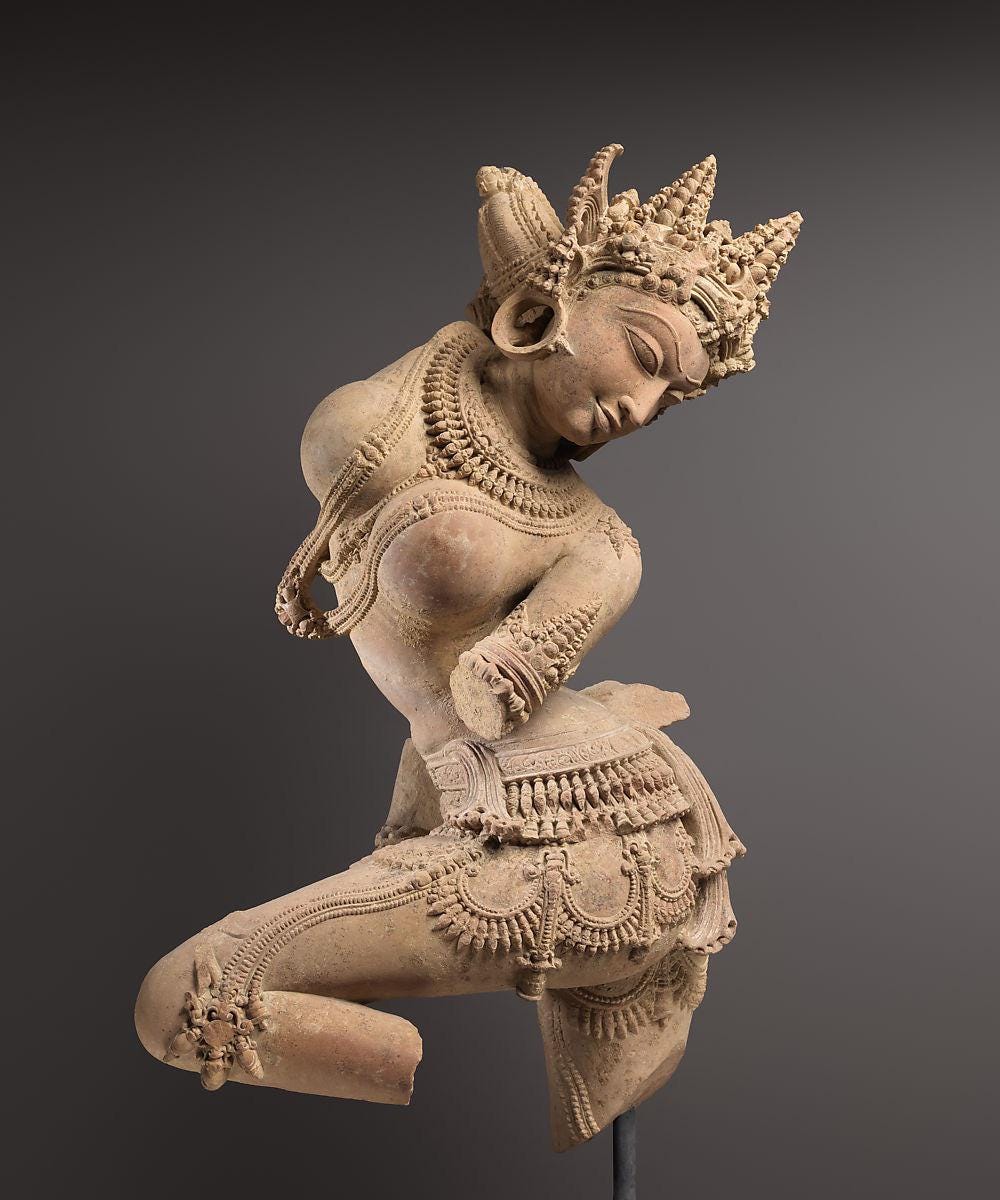
Fig: Celestial Dancer (Apsaras) statue, mid-11th century. Central India, Madhya Pradesh origin. From the collections of Metropolitan Museum of Art.
1
tavocchritān pātayituḥ
patitāṃś coddhariṣyataḥ
vidhatur iva dṛśyante
bhaga citrā vibhūtayaḥ

- Subhāṣitāvalī 2293 Attributed to Vyāghragaṇa
You, who lay low what has gone high and uplift what is down low, seem to have wonderful powers like fate itself, o pussy.
This is a common poetical device in Sanskrit poetry where two things are identified by whatever common activity. So, here bhaga (female genitalia) is said to have powers like fate as it makes things go up and down. bhaga is, as often happens with sexual organs, an euphemism and originally meant something like ‘part’ , ‘portion’ or ‘share’. There was in early Vedic times a god Bhaga who personified the domain of wealth ( as the ‘portion’ that men receive after war ). In Old Persian, the cognate term baga which came to mean ‘god’ generically. In pre-history, tribes that would later become Slavic peoples borrowed this word from the Iranians so that the usual Russian word for god is бог (bog), Ukrainian бог (boh), Polish bóg and so on.
In Sanskrit, it seem to have gone down to euphemism route without, however, the older meaning being ever being forgotten. So, we still get words like bhagavan (possessing bhaga = lord, god, etc.). A particularly egregious example is subhagā (one whose bhaga is good) which means fortunate and is a term for addressing women respectfully. Only when the usual meaning is assumed of course as it wouldn’t usually be respectful address otherwise.
2
raṇḍāḥ pākhaṇḍibhir vyāptāḥ
bhartṛbhiḥ kulayoṣitaḥ
veśyā dhaninam icchanti
chātrāḥ karaparāyaṇāḥ

- Subhāṣitāvalī 2296 Anonymous
Widows are with hypocrites and good women with their husbands. prostitutes want only rich men, so students depend on their hands.
Referring to masturbation of course.
3
ādau namras tataḥ stabdhaḥ
kāryakāleṣu niṣṭhuraḥ
kṛte kārye punar namraḥ
śiśnatulyo vaṇigjanaḥ

- Subhāṣitāvalī 2298 Anonymous
Placid at first, then shocked, hard when the intercourse takes place, placid once again after the intercourse : a merchant is like a dick.
As usual, there is a play on word here that is difficult to maintain in translation. Only perhaps the word ‘intercourse’ is can convey two meanings at once here. The words namras (mild, bent) and niṣṭhuraḥ (hard, obdurate) are used to characterize both the male organ and the merchant. The merchant is mild and soft-spoken while trying to sell his product, then hard as he wants to make much profit and will not give discount, and then mild again when the product is sold.
4
gaṇayati gagane gaṇakaś
candreṇa samāgamaṃ viśākhāyāḥ
vividhabhujaṅgakrīḍāsaktāṃ
gṛhiṇīṃ na jānāti

- Subhāṣitāvalī 2302 Anonymous
The astrologer counts conjunction of asterisms with the moon but doesn't know his housewife addicted to playing with many bon-vivants.
The word bhujaṅga refers to a socialite who doesn’t do any day to day work but just moves on in certain circles and is a womeniser. I used bon-vivants as I don’t know what an appropriate modern term would be. Fuckboy? Chad ? idk.
5
paranārīṣu doṣo’sti
svanārī naiva vidyate
ata eva kulīnānāṃ
praśastā karasundarī

- Subhāṣitāvalī 2303 Anonymous
One can't do it with other women and one's own woman doesn't exist. So, for those of good-birth hand-beauty is recommended.
Similar to the number 2 above.
6
prapāyāṃ prāpyate
vāri satrāgāre’pi bhujyate
supyate devasadane
yabhyate yatra labhyate

- Subhāṣitāvalī 2317 Anonymous
I drink water from the well, food from charities sleep on temple floors and fuck wherever I can.
The original is all in passive which I’ve changed to active as it is quite unintelligible in English otherwise. The verb yabhati ( from root yabh-) is the equivalent of the English f-word. In fact a cognate root is still used in Slavic languages for the same meaning and sounds quite similar to the Sanskrit one. It is exceedingly rarely used in Sanskrit literature outside documentary sources and is proscribed by rhetoricians. I can only recall a couple or so uses in actual literature not counting this and the verse 9 below.
7
nidāghakāle viprasya
prasuptasya taroradhaḥ
śunā pramūtritaṃ haste
devasya tveti so’bravīt

- Subhāṣitāvalī 2318 Anonymous
When a Brahmin was sleeping below a tree in summer and a dog pissed in his hand, he said, "On the impulse of the god....".
A verse making fun of Brahmins. The verse that the Brahmin quotes is from Taittirīyasaṃhitā i.3.1 which reads in A.B. Keith’s translation “On the impulse of the god Savitṛ, with the arms of the Aśvins, with the hands of Pūṣan, I take thee ; thou art the spade, thou art the woman.” It is a popular verse and is particularly used in royal consecrations.
8
chidreṣv anarthābahulībhavantītyalīkametadbhuvi saṃpratītam
chidraṃ puraskṛtya hi kāminīnām arthā bhavantyeva hi na tvanarthāḥ

- Subhāṣitāvalī 2351 Anonymous
I think that saying there's hole in something doesn't always means loss as women are making quite a profit using the holes, not losses.
Probably referring to prostitutes.
9
yabhasva nityaṃ yadi śaktir asti te
dinād dinaṃ gacchati kānta yauvanam
mṛtāya ko dāsyati  darbhaviṣṭare
tilodakaiḥ sārdham alomaśaṃ  bhagam

- Subhāṣitāvalī 2366 Anonymous
Fuck daily if you can, my friend, for youth goes away day by day. When you're dead who'll serve you wet and clean shaven pussy on a plate ?
Carpe diem, I guess?
10
anekair nāyakaguṇaiḥ
sahitaḥ sakhi me patiḥ
sa eva yadi jāraḥ syāt
saphalaṃ jīvitaṃ mama

- Subhāṣitāvalī 2387 Anonymous
Friend, my husband is filled with many heroic qualities. Now, if he was my boyfriend too my life would be complete.
The words of an unfaithful wife to her female friend noting that her husband has all the heroic qualities that she wishes her boyfriend had too.
11
bhikṣo kanyā ślathā te
nanu śapharavadhe
jālikaiṣā’tsi matsyāṃs
te’mī madyāvadaṃśāḥ
pibasi madhu, samaṃ
veśyayā, yāsi veśyām
dattvā’rīṇāṃ gale’ṅghriṃ
kimu tava ripavo
bhittibhettā’smi yeṣāṃ
caurastvaṃ dyūtahetoḥ
kathamasi kitavo
yena dāsīsuto’smi

- Subhāṣitāvalī 2402 Anonymous
"Monk your clothes are wet." "Yeah, I use them as net for fishing." "You eat fish ?" "Yeah, need something to go with alcohol." "You drink wine?" "with whores." "You visit whores?" "After kicking my enemies' necks." "Who are your enemies?" "Those whose house I break into?" "You're a thief ??" "For gambling, yes." "How come you're a gambler?" "Because I'm a son of slave."
This one makes fun of a (probably Buddhist) monk. From the very first answer, the monk’s list of ill-deeds grow on and on. The cause of all this comes down at last to being ‘son of a slave’. Whether this is to be taken literally or not, I don’t know. ‘Son of a slave’ was a generic but not specially strong curse word, akin to say ‘son of a bitch’ in English. It could also, however, be taken literally and as socially stratified as pre-modern South Asia was, it can refer to obvious mockery of the monk by referring to his lowly origins. In a variant version of this verse, the reason is at last ‘what else is a corrupt guy gonna do”.
12
sāmagāyanapūtaṃ me
nocchiṣṭam adharaṃ kuru
utkaṇḍitāsi ced bhadre
vāmakarṇaṃ daśasva me

- Śārṅgadharapaddhati 4062 Anonymous
Don't bite my lower lip hallowed by sāma chants. If you're rally so fired up, bite my left ear.
Probably spoken by a rustic, religious guy to his lover. The next verse is similar in content.
13
prāyaścittaṃ mṛgayate
yaḥ priyāpādatāḍitaḥ
kṣālanīyaṃ śiras tasya
kāntāgaṇḍūṣaśīdhubhiḥ

- Subhāṣitāvalī 2292 Anonymous
He who seeks for purification for being kicked in the head by his lover should have his head washed by liquour out of her mouth.
This verse is sometimes quoted anonymously and sometimes under the name Śyāmalaka. It seems to refer to an one act comedy drama called Pādatāḍitaka by Śyāmalaka probably composed around 450-500 CE but the verse itself is not found there. In this play, whose characters all seem to be real historical individuals, a certain Viṣṇunāga is a military commander who has lead the imperial armies to many conquests but is otherwise a straightforward, religious man. He goes, as the play says, from the court to the temple and from the temple to the court and that’s it. He is kicked in the head by the popular escort Madanasenā during lovemaking. ( You might ask what he is doing with an escort at all despite his previous characterization. I don’t know though if I had to guess I’d say that visiting escorts was normal and expected in ancient times. There even were state run brothels which generated considerable revenue for the government). Viṣṇunāga is furious at this and takes it as a personal affront. He convenes an assembly of Brahmins expert in Law and asks for what penance or purification is enjoined in his case. His listeners are surprised and wonder whether he is mad or possessed. Being kicked in the head by a women during lovemaking is, they think, the very epitome of eroticism.
The verse given above sounds like an ironic purification process someone made up for Viṣṇunāga. The play itself is quite funny and moves on to further shenanigans.
14
gatāḥ kecitprabodhāya
svayaṃ te kumbhakarṇakam
tadadhaḥpavanotsargād
uḍḍīya patitāḥ kvacit

- Subhāṣitaratnabhāṇḍāgāra pg. 364 11
Some of those who had gone to wake up Kumbhakarṇa got blown up and fell down from the air that he blasted.
In the Rāmāyaṇa, Kumbhakarṇa is a demon of gigantic size who, due to a misspoken word while asking for a boon, sleeps six months a year and wakes up the next six. To fight in his final battle, he had to be waken up by a myriad of men with all sort of drums and other noises. This is basically a fart joke making light of the situation.
15
tanvaṅgīnāṃ stanau dṛṣṭvā
śiraḥ kampāyate yuvā
tayor antarasaṃlagnāṃ
dṛṣṭim utpāṭayann iva

- Subhāṣitaratnakoṣa 438 Attributed to Pāṇini
Seeing the tits of slim-waisted maidens, the young man shakes his head as if trying to pluck away his gaze that are stuck deep between them.
This one is ascribed to Pāṇini. As the famous ancient grammarian is the only known author of that name, it probably refers to him. It is unlikely to be authentic. As for the ‘slim-waisted’ ones, ancient ideals of female beauty were such that contemporary Instagram proportions might seem actually reasonable. There are, for example, many descriptions of heroines and lovers in poetry where she has such large breasts and such a thin waistline that she can only walk with difficulty and has to stoop down. Here’s an ancient statue for a visual demonstration:
![r/ArtefactPorn - Youthful Indian Damsel, Chandraketugarh, INDIA, 3rd Century[1080 x 1393]](./images/image_3.jpeg "r/ArtefactPorn - Youthful Indian Damsel, Chandraketugarh, INDIA, 3rd Century[1080 x 1393]")
Fig: Sculpture from Chandraketugarh in Bengal. 3rd century.
16
tvāṃ vīkṣyodyatadaṇḍo’smi
nityamāyatalocane
nityamudyatadaṇḍaḥ syād
ācāryāṇāṃ mataṃ kila

Seeing thee, o long-eyed one,
I am "he who has an upright rod".
"Let him always have an upright rod",
such is the view of the teachers.
To end the post, this is a verse by a more modern poet - me ! The Sanskrit text has a pun and a quotation and is difficult to render in English without sounding stupid. It is a double entrede like some of the poems above and refers to Kauṭilya’s Arthaśāstra 1.4.03-05 :
“ānvīkṣikī trayī vārttānāṃ yogakṣemasādhano daṇḍaḥ, tasya nītir daṇḍanītiḥ, alabdhalābhārthā labdhaparirakṣaṇī rakṣitavivardhanī vṛddhasya tīrthe pratipādanī ca | tasyām āyattā lokayātrā | tasmāl lokayātrārthī nityam udyatadaṇḍaḥ syāt |” which Patrick Olivelle translates as
“What provides enterprise and security (6.2.1 n.) to critical inquiry, the Triple, and economics is punishment (daṇḍa); its administration (nīti) is government (daṇḍanīti). Government seeks to acquire what has not been acquired, to safeguard what has been acquired, to augment what has been safeguarded, and to bestow what has been augmented on worthy recipients. 4 On it depends the proper operation of the world. 5 “Seeking the proper operation of the world, therefore, he should always stand ready to impose punishment; 6 for there is nothing like punishment for bringing creatures under his power”—so state the teachers.”
The “ready to impose punishment” is in the original “udyatadaṇḍaḥ” meaning “one whose rod is upright”. The “rod” here refers to the royal staff and signifies the king’s readiness to impose punishment on wrongdoers. The other meaning of “one whose rod is upright” should be clear even in the English translation.
If you like my writing, please subscribe to receive similar posts in the future. If there are any errors on my part, I would be grateful to have them pointed out in the comments. Thank you.