On Learning (Dead) Languages
My experience of learning languages as an autodidact.
When I was a kid, I thought it was obvious that anyone who says he knows a language would be comfortable speaking or listening or reading in that language with reasonable fluency. What else could it mean? As I’ve tried to learn some languages on my own - successfully I’d like to think, two things, mostly unrelated, have challenged this perception.
The first is in the teaching and learning of older languages with no native speakers[1]. Often, the authors of any language learning book or resource for such language take it for granted what the student wants and will ultimately be able to do is not to read a text in that language as one would read in a modern language but to build a code through which he will translate ( with a dictionary and a lexicon at hand of course) into his native language. As such, you learn not the language but enough about the language to tease out a translation that makes sense.
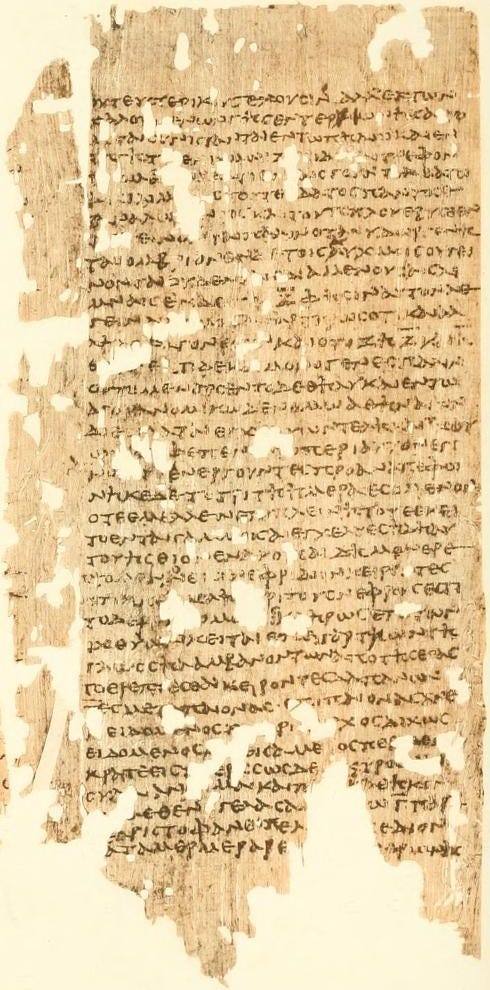
Papyrus from the Oxyrhynchus site. Scholia to Homer’s Iliad 21.
This is what is often called the “traditional” or “grammar-translation” method of learning a language. You learn the paradigms, find out the verb, the subject and the object and translate them in a sequence, then, voila! the sentence makes sense. Or so its propounders claim. It is “traditional” for though it may appear to some people, who have only ever known this way of learning, to be the natural or the God-given way of learning languages, it is mainly the product of nineteenth century German classical scholarship. Before that the language learning ways might not have represented entirely the results of modern Second Language Acquisition research, but were certainly closer to it than the “traditional” Grammar translation method.
The second method is called “Comprehensible Input Hypothesis”. It was developed by Stephen Krashen in the 1970s and states that a learner’s competence in a new language depends mainly on the input which should be just about comprehensible (i.e. not very much above the learner’s level). By consuming large about of input material and with incremental development, the learner would naturally be fluent in the target language. An important distinction is meant between ‘learning’ a language and ‘acquiring’ it.
There have been many developments in the field of Second Language Acquisition in the decades after Krashen’s work came out. There have been both criticisms and modifications of his initial ideas and dozens of studies that seek to learn whether this or that hyper-specific model is more likely. In the field of learning ancient languages, however, people can roughly be divided to those who use the traditional Grammar-Translation method and those who are opposed to it.
The second point is about the absolute shitshow that online polyglot ecosystem is. It is hard to imagine a field where there is so much open grifting on topics that a reasonably large section of society knows about. Bilingual people are not rare in any part of the world and polyglots are not uncommon either. How then is it that these buffoons make fortunes by just pretending to speak a gazillion languages and SHOCKING people in their local Chinatown by speaking fluent Mandarin or something, I am really unable to understand. Something akin to Gell-Man Amnesia I suppose.
Anyway, what follows is my own experience of learning ‘dead’ languages. It contains whatever random thoughts that I have on the topic in no special order. This account is aimed towards autodidacts. Except for English, I have never taken any language classes in my life and all the languages I know to whatever meager level that I do are learnt from self-study.
My Method
I start with a simple grammar translation textbook. For ‘dead’ languages these are usually not rare. Many were published way back in the day and are in the public domain now. I go through these within a short period of time (from a couple of days to a week) and skip all the exercises. One would, of course, not get much of this and retain hardly anything but it does come handy in the next step.
After breezing through the grammar translation textbook, go through a graded reader or a natural language book. There’s Lingua Latina and its companions for Latin, Athenaze for Greek[2] and Osweald Bera for Old English. I’d read a new chapter each day. Before starting a new chapter each day, I reread the previous chapter and review the vocabulary of the previous chapter to make sure I’ve not forgotten much vocabulary. It takes around a month to two months of about 1 hour a day depending upon the language to complete this. When one goes through the reader, he’ll keep on noticing things he had seen in the grammar textbook but now in enough context. This is the reason for breezing through the grammar in the beginning. Although many of these graded reader or natural method books can technically be started by complete beginners, it feels to me much easier if you already have a rough idea of grammar beforehand. That said, many of these books do contain grammar explanations. Lingua Latina has a brief grammar lesson in Latin following each of its chapters. There’s also a Companion volume in English that is much more extensive. Athenaze has such explanations too. Osweald Bera doesn’t but Old English is comparatively easier than Latin or Greek and after going through a grammar textbook once, it should not be hard to continue without explanations every chapter.
Now there are a lot of proponents of Natural Method proponents on the internet and some overenthusiastic ones may have led you to believe that once you complete a Lingua Latina or an Athenaze you could read any text in your target language with sufficient ease[3]. Well, you can’t. Not because they are necessarily bad or ineffective but because getting close to fluency in a language takes a lot of extensive reading. These readers are all about 40,000 words at most. One needs to have read hundreds of thousands of words if not millions to get even close to any reason definition of fluent reading.
The last step therefore is to just start reading authentic texts. I search for texts that have reputations for being comparatively easier. Readers adapted for beginners are usually available for these texts. For Greek and Latin, Geoffrey Steadman has a lot of these readers with glossary and commentary on the same page as the text so that the reader need not turn page every time a new word is encountered. He even provides the pdfs for free though I should suggest buying the physical copies themselves to support the great work. Faenum Publishing has similar readers.
A month or two of reading progressively harder texts in your target language for an hour a day will then leads to be reasonably comfortable in that language.

Fig: Young Cicero Reading. By Vincenzo Foppa (c.1427–c.1515)
A Disclaimer
I have tried to avoid any prescription in the description of how I learn languages. I have neither any magic language pill to sell nor any courses to grift. What worked for me may or may not work for you. Maybe you have limited time and cannot just allocate an hour a day, maybe you just don’t like studying through books and want to join a real class. There may be many factors. These are just the ways I learnt languages on my own as an autodidact and are intended just to show that it is possible to be reasonably competent in ‘dead’ languages within a reasonably short amount of time - about 3 to 4 months. Neither do I want to encourage people to set unrealistic expectations. If you get there in 6 months rather than 4, or even a year, it’s not the end of the world, is it?
It is possible to read and not just decode
Of course, you’d not reach C2 (or whatever the equivalent would be) but it really is not impossible to just read Caesar in Latin like you’d read in English, or whatever your native language is, with just occasionally looking up unknown words. If you follow any Latin or Greek communities, this is often referred to as ‘sight-reading’. You ‘sight-read’ a Greek or Latin text when you look at the page and just … understand what it means.
Someone not already familiar with ancient language pedagogy might be bit surprised here. Isn’t that just reading? What else is one supposed to do? Of course, it’s just reading. It exists because there’s a view, unfortunately not rare, that it is not possible to just read ancient Latin or Greek texts cover to cover and the only way to understand them is to go over each sentence searching for parts of speech: here is the verb, what is the subject, what case is it in and so on and then translate them until it all fits to give a meaning.
Even someone as influential as Mary Beard have voiced such opinions. She says:
People often imagine that if you ‘know Latin’ you can read more or less any bit of the language that is put in front of you (much like what you can do if you ‘know French’). It isn’t really like that at all. …
I still remember an eye-opening moment when some elderly professor of Greek, giving a visiting lecture when I was an undergraduate at Cambridge, boldly stated that the only Greek authors he could read fluently were Homer and Herodotus…
I quote Mary Beard not because she is necessarily unusual but because she is an academic who is well known for her public-facing books and works. Also, because the linguist A.Z Foreman did a great piece some years ago on her comments that I agree with completely. He is an actual linguist and puts it in much better terms than I ever could, but the conclusion is the same. It is possible, even preferable, to learn Latin (and many other ostensibly ‘dead’ languages) to a level where one can read them as one would read his native language. Of course, this is not to say explicit grammar or close reading is useless but the dichotomy itself is false.
Use digital resources
Of course, one should use digital resources in 2026. I’ll just use one example. In the process of reading easy texts extensively, you’ll certainly encounter new words that cannot be understood from the context alone. Looking them up in a dictionary, either physical or online, manually is exhausting. There are many tools available on the internet to make it easier. For Latin or Greek, there’s Perseus where you can click any word and you are redirected to a dictionary entry for that word with complete parsing. There are, however, many works that you may want to read that aren’t available on Perseus. Just use Alpheios’ chrome extension. It works for both Greek and Latin (and for some other languages) and works for any website. For Sanskrit, there is this extension that does the same. I’m not sure anything similar exists for Old English but Peter S. Baker has, beside other resources, a lot of text in his wonderful site and has notes beside the simple dictionary entry.
Vocabulary Acquisition is more difficult than grammar
Many people learning a new language, either dead or contemporary, often complain about the grammar that they have to learn. For native English speakers, this often includes making fun of grammatical genders that are present in other languages or case system and so on. It is admittedly true that many languages, especially our ‘dead’ languages like Ancient Greek, have complicated grammar that aren’t immediately intuitive to a beginning learner. Still, it has been my experience that grammar is usually not the most difficult part of learning a language. Vocabulary acquisition is much, much harder. You cannot just cram all necessary vocabulary (is there even such a thing?) at once and unlike grammar, which is limited in extent for beginners, the amount of vocabulary that one needs to know to even a supposedly easier ‘real’ text is quite large. Some people like to use techniques like spaced repetition but I personally don’t enjoy learning standalone vocabulary without context. Anyway, it is only after reading a large amount of texts in gradually increasing level of complexity and internalizing thousands and thousands of words, that one gets a feel for a language or Sprachgefühl as the Germans call it.
Old languages aren’t necessarily more complex
People often claim that ancient languages were more complex than modern tongues. This seems to be often paired with juxtaposition with the ‘simpler’ English and the idea that knowing Latin or Greek would lead to better ‘critical thinking’ or something like that. It is not easy to just compare two languages and just label one more ‘complex’ than the other. These things are necessarily subjective. Much, for example, depends upon the native tongue of the learner. People whose native language doesn’t have cases, like English for example[4], often find case and declension difficult. But doesn’t the presence of grammatical cases automatically mean more complex? English is complex in its own ways. Latin, for example, doesn’t have the same difference between definite and indefinite articles that English has (a/an vs the). Many speakers of language that have cases but no articles, like Russian, find it difficult initially to get a feel for how articles are supposed to be used. As for ‘complex’ languages teaching a person ‘critical thinking’ why learn Latin or Greek at all? Just learn Hungarian with its myriad of cases. If you want an Indo-European language specifically, learn Lithuanian or something.
Speaking and Writing too?
Can you speak a dead language? Can you produce new content, even literature, in it? Of course it is possible. I have thousands of lines of Sanskrit verse and hundreds of lines of Latin verse that I composed lying in my own notebooks. I’d like to have them digitized somehow but I’m not dedicated enough to type them myself and OCR is more trouble for handwritten texts than its worth. And I’m neither prolific nor have a particular mastery of these languages that many, many people possess even today. Of course, other ‘dead’ languages may be less popular but even Old English, Old Norse or Gothic have some small communities where people communicate in those languages and compose their writing in them.
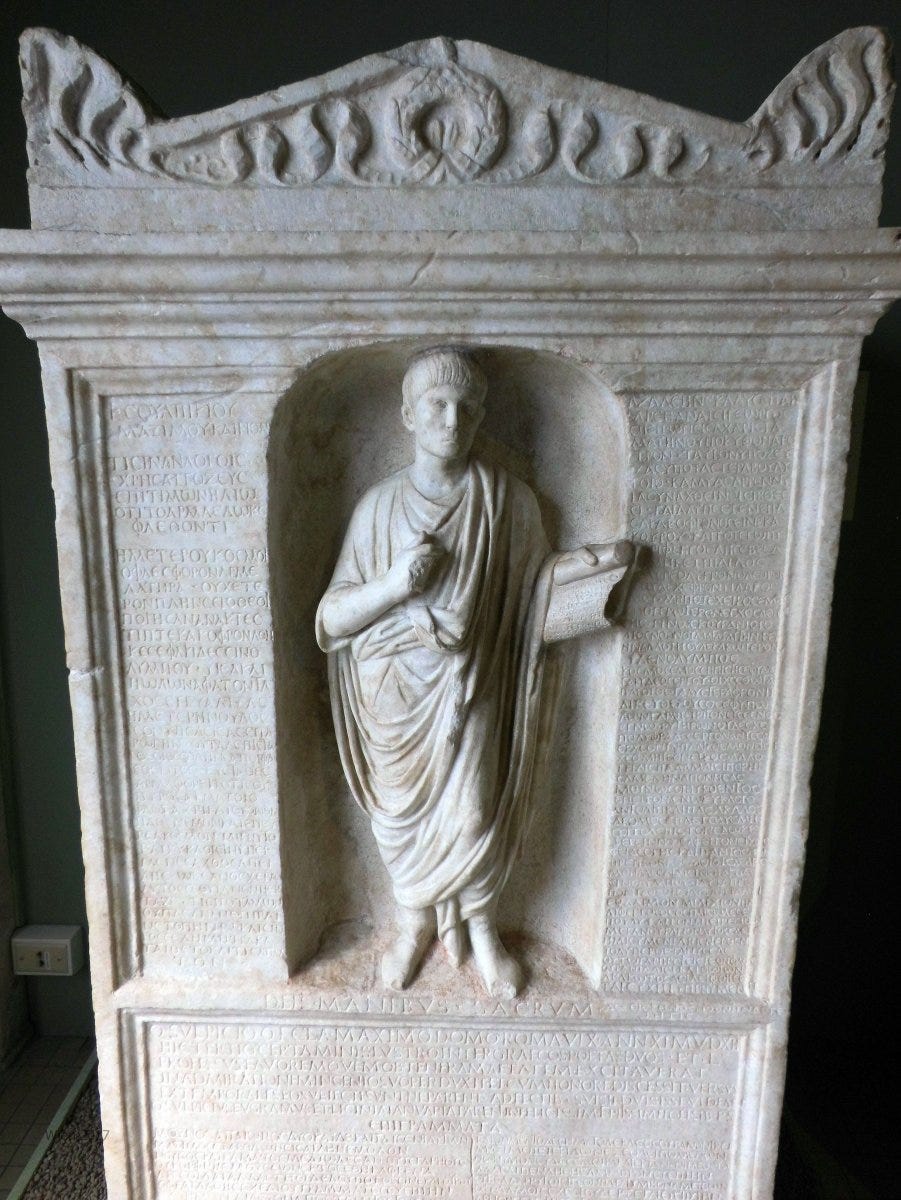
Fig: Tombstone of a certain Quintus Sulpicius Maximus (82-94CE). His face looks older here due to certain Roman beliefs about the afterlife but he died aged just12 after winning a poetry contest (in Greek) in the Capitoline Games. His father included his poetry in the tombstone. If a 12 year old boy who learnt Greek as a second language could write award winning Greek poetry, what’s your excuse?
As for speaking, it is, generally speaking, possible too. People who haven’t studied ‘dead’ languages or don’t have much idea of linguistics seem surprised that we generally have a fair idea of how ancient languages sounded like[5]. Of course, there will always be details that linguists disagree about and it is not feasible to map out all the dialects and variations that exist in all languages where the evidence is limited but the sounds of say, Classical Latin in the late Republic or of Attic Greek in the Classical Age are, generally speaking, reasonably known.
Of course, some people have no intentions of speaking and learn ancient and medieval languages solely to read and engage with written texts. I won’t say this is necessarily wrong or harmful but it is my personal experience that speaking a language, even to a limited extent, helps improve reading and writing skills as well. Of course, reproducing exactly the sounds that are not present in one’s own native language is not easy and is more so for languages where there are no native speakers to imitate in natural setting. I cannot still pronounce the syllabic r in Sanskrit (ṛ). Still, even if you don’t intend to use them, it is good to have a fairly correct idea of the standard pronunciation.
Well, that’s more or less it. I’ll add some more sections in the future especially a section on useful resources. Have you learnt a ‘dead’ language? Do you intend to? Leave a comment which ‘dead’ language you have learnt or wish to learn in the future.
If you like my writing, please subscribe to receive similar posts in the future. If there are any errors on my part, I would be grateful to have them pointed out in the comments. Thank you.
Dead language is the common but rather loathsome name. In linguistic parlance, it is often used for languages that have no native speakers and thus are frozen in time but it often gives a false idea to the layperson that these ‘dead’ languages cannot actually be spoken and also blurs the distinction between actually extinct languages (like that of the Indus valley inscriptions) with languages like Latin or Greek for which there is an unbroken chain of transmission from native speakers in the ancient world to the scholars in the modern day, i.e. unlike say Etruscan or Sumerian. There was never a point in history for the last two thousand years when no one could actually understand Latin in a fairly accurate way. It also suggests, at least subconsciously, that trying to speak or, God forbid, revive such languages is a misguided at best and actively reactionary at worst - a sort of necromancy. ↑
There are two versions of the Athenaze books; one in English and one in Italian. The Italian one is, in my opinion, far, far better in all aspects. It has nearly twice the amount of text compared to its English counterpart. If you know any Italian ( or even any Romance language) or are willing to use Google Translate,I’’d recommend using the Italian version rather than the English one. ↑
I am just referring to the impression one may get from enthusiastic amateurs. Professionals are well aware that just reading a single ‘natural method’ book would not magically lead you to fluency. ↑
There are some vestiges of a case system in Modern English like he/his/him though. ↑
Well, maybe not languages like Sumerian or Old Egyptian but for more popular ‘dead’ languages like Greek, Latin, Sanskrit, Old English, Old Icelandic, Hebrew, etc., this is generally true. ↑