Laments of a bronze age gambler
On Dice, Destiny and the Oldest Addiction
I have a long post in the drafts about whether the unflattering depictions of non-western peoples by early orientalists (in the original sense of that term) are all just orientalist (in the modern sense of that term) fantasies or even depictions that seem to just call out for anti- and de- colonial ‘deconstructions’ do have some truth to them. I’m lazy and write slowly. So it will probably remain in the drafts for a long time to come. One of the topics I will discuss in that post is that most nineteenth and twentieth century accounts of Nepal by English authors seem to emphasize the vice of gambling that was supposedly deep set. This passage from William Brook Northey’s Land of the Gurkhas (1937) is perhaps the most descriptive of them all:
If, however, the Nepalese can be acquitted of any undue tendency to drink, the same can hardly be said of their passion for gambling, to which they are certainly inordinately addicted. In general, gambling in public is strictly prohibited in Nepal, except on certain very special occasions such as that of the Diwali festival. But as we all know, it is one thing to make laws of this kind and quite another to secure their enforcement, and the Nepalese in point of fact gamble at all times and in all places whenever they can possibly manage to do so.
Here, as in the case of drink, Sir Chandra Shumshere[1] was fully aware to the evil, and, as one means of checking it, introduced legislation prohibiting the giving of credit to the loser and compelling the payment of all debts of this kind in cash on the spot, whereby a certain amount of good was certainly affected, though naturally hardly making much difference in the case of such orgies as those of the Diwali festival when all restraint is thrown to the winds.
The street scenes in Kathmandu and the other towns of the valley on the occasion of this particular festival must be experienced indeed to be believed. Upon the beat of a drum every other occupation is immediately abandoned by one and all and the whole population gives itself up forthwith to its one all-absorbing passion, for which, as it is hardly necessary to add, opportunities in plenty are provided. For not only are there innumerable booths in every street with their enticing “tables”, but practically every house and shop in addition has its own gambling party all feverishly engaged in some form of play.
…
Many and extraordinary too, not to say incredible, are the stakes for which they play, as authentic records attest. Thus men have been known to stake their wives and children on a throw of the dice, while one man is even said to have cut off his left hand and put it down under a cloth as his stake. It is recorded further that on winning the game, he insisted on his opponent cutting off his hand, or else restoring all the money which he had previously won.
The last anecdote about the hand cutting man is a particular favourite among these authors although contrary to what Northey says it is just a popular rumour for which no ‘authentic record’ exist. The conclusion I draw in the piece is that both the legal and documentary sources do show that gambling was indeed widespread at the time and that the government was at times compelled to ban it completely, at others to merely restrict it.
What to do with gambling is a question relevant not only to the individual but to society at large as the losses of the gambler often leads not only him but his family to ruin as well. As in modern times, there were various ways that the state and various thinkers responded to gambling in ancient times. For the specific case of South Asia, the two diametrical attitudes towards gambling may be exemplified by the texts of Kauṭalya’s Arthaśāstra and the Mānavadharmaśāstra respectively.
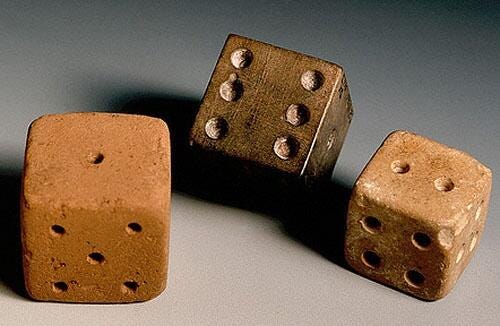
Fig: Dice from Indus Valley Civilization. 2500-1900BC. Source.
While Kauṭalya has state-run gambling dens which pay taxes to the state and has well defined laws for dealing with any disputes that arise, Mānavadharmaśāstra summarily condemns gambling and has the king punish the gamblers with, believe it or not, execution.
The king shall suppress gambling and betting within his realm; they are the two vices of rulers that devastate a kingdom. Gambling and betting amount to open theft; the king should make constant effort at eradicating them both.
When it is done with inanimate things, people call it "gambling"; when it is done with living beings, on the other hand, it is known as "betting." The king should have anyone who engages in or facilitates gambling or betting executed…
Mānavadharmaśāstra IX.221-224 (From Patrick Olivelle’s translation)
Modern readers, for understandable reasons, tend to appreciate Kauṭalya’s method. But the more I have suffered from the ills of gambling personally and the more I hear or read of other such horror stories, I do wonder whether some sort draconian laws against institutional gambling, not execution of course, may not be as bad as people think. Modern world, however, seems to be moving in the opposite direction. In particular online betting (or ‘Prediction Markets’) that have risen over the last decades seem to me to be absolutely despicable development. Even Substack has now integrated a prediction platform. Oh well …
In any case, what I think or don’t changes nothing at all in the world. This post isn’t about the state of modern betting either. I just have a nice poem to translate on the evils of gambling, not from modern times but from the late bronze age.
Though the vast majority of the 1018 hymns included in the Ṛgveda are, expectedly, religious and ritual in nature, there are a few that are not. Some scholars have used the word ‘secular’ in reference to them. I do not think ‘secular’ is a good descriptor for this. I would characterize them as ‘not explicitly religious’ rather than ‘secular’. In any case, there are a dozen or so of these poems.
In one of these, the 34th hymn of the tenth book, a gambler laments about his woes. The tenth book is usually considered to be the latest book of the Ṛgveda and includes more popular material which are largely absent from the other books which are concerned with the orthodox and hieratic Soma-cult.
This little hymn is, as far as I know, the oldest one of its type. There may be some older things in Mesopotamia but I know of none which reach the same level of literariness. As for the date, it must have been somewhat older than ~1000BC but by how much I cannot say.
The language itself is more modern than the archaic hymns - almost comprehensible to those who understand classical Sanskrit. It is composed, in my view, in a simple but emotionally evocative style which is only rarely the case with its contemporaries. It is not an accident that this piece has been repeatedly translated, anthologized, quoted and so on.
Macdonnell calls it a ‘striking poem’.
Brereton and Jamison introduce their translation with, ‘ The monologue form found here is almost unprecedented in the R̥gveda, and the shifting play of emotions—guilty excitement, tender remembrance of his past life and family, scorn for his own weakness and the disgust he arouses in others, bitter anger at the inanimate dice that brought him low, to which he ascribes agency and malign intention and for which he still longs—is psychologically convincing and very moving. Showing our own biases, we might proudly deem it quite “modern.” '
Moriz Winternitz says of it, ‘But the most beautiful among the non-religious poems of the R̥gveda-Samhita is the song of the gambler, RV X. 34. It is the monologue of a repentant sinner who has destroyed his happy life by his irresistible love for gambling. In verses composed in a language that moves the listeners the gambler describes how the dice have robbed him of his domestic happiness:’
In addition to the the hymn itself, the identity of its author is interesting as well. The verses reference the dice games used for gambling as well. These are quite different from the games played nowadays. I have discussed them below the translation. Vibhīdaka is a brown nut used as dice. This is the fruit of a tree called Terminalia bellirica.
The original and my translation follow now. My translation, though divided into lines, is to be considered formatted prose and not poetry (of which I am mostly incapable of composing anything even remotely bearable in English). The text bounces between the third and the first persons. I have kept this as is.
Original
prāvepā́ mā bṛható mādayanti
pravātejā́ íriṇe várvṛtānāḥ
sómasyeva maujavatásya bhakṣó
vibhī́dako jā́gṛvir máhyam achān  1

ná mā mimetha ná jihīḻa eṣā́
śivā́ sákhibhya utá máhyam āsīt
akṣásyāhám ekaparásya hetór
ánuvratām ápa jāyā́m arodham  2

dvéṣṭi śvaśrū́r ápa jāyā́ ruṇaddhi
ná nāthitó vindate marḍitā́ram
áśvasyeva járato vásniyasya
nā́háṃ vindāmi kitavásya bhógam  3

anyé jāyā́m pári mṛśanti asya
yásyā́gṛdhad védane vājī́ akṣáḥ
pitā́ mātā́ bhrā́tara enam āhur
ná jānīmo náyatā baddhám etám  4

yád ādī́dhye ná daviṣāṇi ebhiḥ
parāyádbhyo áva hīye sákhibhyaḥ
níuptāś ca babhrávo vā́cam ákratam̐
émī́d eṣāṃ niṣkṛtáṃ jāríṇīva  5

sabhā́m eti kitaváḥ pṛchámāno
jeṣyā́mī́ti tanúvā śū́śujānaḥ
akṣā́so asya ví tiranti kā́mam
pratidī́vne dádhata ā́ kṛtā́ni  6

akṣā́sa íd aṅkuśíno nitodíno
nikṛ́tvānas tápanās tāpayiṣṇávaḥ
kumārádeṣṇā jáyataḥ punarháṇo
mádhvā sámpṛktāḥ kitavásya barháṇā  7

tripañcāśáḥ krīḻati vrā́ta eṣāṃ
devá iva savitā́ satyádharmā
ugrásya cin manyáve nā́ namante
rā́jā cid ebhyo náma ít kṛṇoti  8

nīcā́ vartanta upári sphuranti
ahastā́so hástavantaṃ sahante
divyā́ áṅgārā íriṇe níuptāḥ
śītā́ḥ sánto hṛ́dayaṃ nír dahanti  9

jāyā́ tapyate kitavásya hīnā́
mātā́ putrásya cárataḥ kúva svit
ṛṇāvā́ bíbhyad dhánam ichámāno
anyéṣām ástam úpa náktam eti  10

stríyaṃ dṛṣṭvā́ya kitaváṃ tatāpa
anyéṣāṃ jāyā́ṃ súkṛtaṃ ca yónim
pūrvāhṇé áśvān yuyujé hí babhrū́n
só agnér ánte vṛṣaláḥ papāda 11

yó vaḥ senānī́r maható gaṇásya
rā́jā vrā́tasya prathamó babhū́va
tásmai kṛṇomi ná dhánā ruṇadhmi
dáśāhám prā́cīs tád ṛtáṃ vadāmi 12

akṣaír mā́ dīvyaḥ kṛṣím ít kṛṣasva
vitté ramasva bahú mányamānaḥ
tátra gā́vaḥ kitava tátra jāyā́
tán me ví caṣṭe savitā́yám aryáḥ 13

mitráṃ kṛṇudhvaṃ khálu mṝḻátā no
mā́ no ghoréṇa caratābhí dhṛṣṇú
ní vo nú manyúr viśatām árātir
anyó babhrūṇā́m prásitau nú astu 14
Translation
The dangling ones excite me greatly, these nuts:
born in windy places, rolling in the board.
Like a drink of Soma from Mount Mūjavat,
I like this watchful vibhīdaka nut.  1

She did not hate me or argue with me
but was graceful to my and my friends.
But for a dice that scored just one,
I've turned away my faithful wife.  2

Mother-in-law hates him, wife turns him away,
a distressed guy finds no one to console him.
“Like an old horse that has been put out for sale,
I find no use for this gambler.”   3

Others people caress the wife of the man
for whom the dice has turned greedy for prize.
His father, mother and brothers say about him:
“We don’t know him. Bind and take him away.”  4

When I think that I will not play with them,
I’m left alone by my friends who go away;
the brown nuts make a sound when thrown
and I go anyway, like a women in love to her spot.   5

The gambler goes to the hall asking,
“Will I win?”. He is puffed with his body.
The dice run contrary to his wishes
and give perfect score to his opponent.  6

The dice: sharp pointed, stabbers,
debasers, fiery, scorching hot,
volatile like a child, defeating the winners.
These, sweet like honey, are gambler's banes.  7

Their war-band, fifty three in all, plays
like the god Savitṛ whose laws are true.
They don’t bow even to the fierce.
Even the King bows down to them.  8

The turn down, they flicker up.
Handless they smite those with hands.
Like divine coals, thrown to the board,
they are cold but burn down the heart.  9

The gambler’s wife, left alone, is tormented
and his mother when her son is god knows where.
Heavily in debt and wanting more wealth,
he goes to others houses at the cover of night.  10

It pains the gambler to see a woman:
the wives of others or their well groomed beds.
He yokes the brown horse before the break of dawn
and falls down, like a bull, when the fires end.  11

Whoever is the leader of your bands,
The king, first among the war band,
I bow down to him: I’m not hiding any wealth.
All ten fingers before me. I’m telling the truth.  12

Don’t play with dice. Plough your fields.
Be happy with your own wealth, think it enough.
There, gambler, are your cows; there your wife.
So the noble Savitṛ says to me.  13

Be friends with me. Be gracious to me.
Don’t turn your evil [eyes] towards me.
May your hateful battle-fury tone down.
Let another be the possessed by the brown [nuts].   14
On The Author
The identity of the author is also interesting. The ancient indexes ascribe this poem to either a person named Kavaṣa Ailuṣa or to Akṣa Maujavant (The Dice from Mount Mūjavat). After long and difficult deliberations, I have decided to rule out the second option as the author.
This Kavaṣa Ailuṣa is interesting because unlike the vast majority of Ṛgvedic seers, he seems to have a patently un-Aryan name. No other person of this name is known except for a certain ‘Old Kavaṣa’ who appears in the Battle of the Ten Kings. Whether this is the same as our author is unknown. Probably he is not.
Then famous old Kavaṣa he wrenched down into the waters, and Anu and Druhyu—he with the mace in his arms. The ones devoted to you, who cheered you on, (were) choosing there your partnership for their partnership.
In an instant Indra split open all their fortified places, their seven strongholds, with his might. He shared out the patrimony of the descendant of Anu to Tr̥tsu. We defeated the Pūru of scornful speech at the rite of distribution.
Ṛgveda VII.18 (From Jamison and Brereton’s translation)
But an interesting story is told in later times about this Kavaṣa Ailuṣa which explains his name. His mother, as it turns out, was an un-Aryan Dāsa woman.
ṛṣayo vai sarasvatyāṃ satram āsata te kavaṣam ailūṣaṃ somād anayan dāsyāḥ putraḥ kitavo’brāhmaṇaḥ kathaṃ no madhye’dīkṣiṣṭeti tam bahir dhanvodavahann
The seers performed a sacrificial season on the Sarasvati; they drove away Kavaṣa Ailuṣa from the Soma, ‘The child of a slave woman, a cheat, no Brahman; how has he been consecrated in out midst?’ They sent him out to the desert, …
Aitareyabrāhmaṇa II.19 (From A.B Keith’s translation)
Kavaṣa Ailuṣa does manage, by supernatural means, to get back and comes out victorious in this case but the insults labelled at him are interesting nonetheless. The word translated as “cheat” by Keith is ‘kitava’ which normally means ‘gambler’ and is infact the very word that occurs again and again in the verses ascribed to him that we translated above. Maybe he was actually a gambler in real life after all. In any case, gamblers, especially those who lose (which is practically most of them), don’t seem to have a very high social status, neither then nor now.
I would not personally characterize the supposed author as the ‘downtrodden’ or ‘subaltern’ and make a big deal about supposedly ancient piece of ‘subaltern’ literature but for people who are into that sort of thing, there is enough material here to work with. It is also interesting that it is from an author so characterized that we get one of the simplest (in grammatical terms) and charming composition as compared to the arcane and bewildering style of the more elevated seers. Some of this maybe due to the lapse of time as very archaic language tends to be the most difficult but surely it is not the whole reason. The compositions attributed to Vasukra Aindra (X.27-29) that are placed just before those attributed to Kavaṣa Ailuṣa (X.30-34) are similarly late in date but are some of the hardest to understand.
How to gamble
As I said earlier, the dice are repeatedly referred to as ‘brown’ in the text. These were the vibhīdaka nuts. The exact method of playing the game is not entirely clear but it must have been something like this.
There were a large number of nuts used as dice (cf. fifty-three in verse 8) which were thrown into a set place in the ground. The nuts were then thrown and somehow separated (maybe by a depression in the ground or something like that) so that what was left wad divided by five. If the remaining number of nuts after the division is four, that is the best score called kṛta. This is the best result. If the results are three, two and one respectively, they are called tretā, dvāpara and kali respectively with each being worse than the preceding score. So when our gambler says that “But for a dice that scored just one, I have estranged my faithful wife.”, what is meant is that he got the lowest possible score in the game after turning away his wife to play it.
These names for scores in a dice game would hardly be anything more were they not ultimately responsible for giving their names to the four world-ages: kali-yuga and so on.
Some Notes on the Translation
Verse 1
Mūjavat is the name of (probably legendary) mountain where Soma was brought down from heaven for the use of mortals. If there was a corresponding real mountain, it must have been somewhere in the Hindu Kush.
The iriṇa is more correctly not a ‘board’ but an area of ground with a little hollow made for the game.
Verse 3
Some have interpreted the ‘mother-in-law’ as not the gambler’s mother in law but the mother in law of his wife, i.e. a circumlocution for his his mother who has disowned him. This is accepted by many scholars but I really don’t get it.
The last two lines are the direct speech that is said about the distressed gambler.
Verse 5
- ‘like a woman in love to her spot’ or more correctly the gambler goes to his den like a woman in love goes to her secret designated location to meet her lover.
Verse 6
- The original jeṣyā́mī́ti of the second line can be interpreted either as a statement ‘I will win.’ or ‘Will I win?’.
Verse 8
- The group of nuts is repeatedly likened to a war-band also in verses 12 and 14.
Verse 10
- ‘he goes to others’ houses at the cover of night’. Probably to steal or to ask for loans. It is unclear what the reason is.
Verse 11
It pains gambler to see other women or to see their lives because his own is ruined.
The brown horses maybe referring obliquely to the brown nuts of dice.
vṛṣala is a diminutive form of the word for ‘bull’. In later times it is an insulting word for low caste people. This sense had probably not developed by the time considered here but considering the identity of the author, it is not impossible.
The phrase ‘when the fires end’ refers to late night.
Verse 12
vrāta is the Vedic equivalent of Indo-European kóryos or männerbund.
‘I’m not hiding any wealth’. Many translations have ‘money’ instead of ‘wealth’. I’ve not done that because ‘money’ implies physical currency like coins which would not come into use until centuries later. As for what he is supposed to be not hiding, maybe gold or something, idk.
Verse 13
This verse is quoted almost 3000 years later in an early modern satirical poems about praising ugly water buffaloes of all thing. That is an interesting poem too. I’ll write about it someday if I feel like it.
‘noble’ or more literally ‘Aryan’. Interesting the word here with short a initial vowel instead of the more common long a.
Verse 14
manyu which is translated as ‘battle-fury’ here is probably cognate to Greek μῆνῐς (mênĭs), the first word of the Iliad.
I cannot remember the exact video now but in some interview, Jackson Crawford and his guest once mention that a crucial difference between the worldview of modern people as opposed to their pre-modern counterparts is that for pre-modern bad things will happen. They just hope that those things will happen to someone else. Where we might say, “Let this gambling habit not ruin me”, they would say “Let this gambling habit ruin someone else, not me.” This is of course not a hard and fast rule but it is an interesting observation and one which I agree with.
This last verse makes is similar in content to some later prayers in which a gambler prays for victory.
A last reminder
Though anyone who is already used to gambling is not going to take my unsolicited advice and those who don’t gamble have no need for, I offer it anyway. Don’t gamble guys. It’s not worth it. There are no diamonds at the end of the tunnel. Unless you are literally an Übermensch beyond the grasp of us mere mortals or are using insider info in online betting or something, it’s not a good thing. You will lose. I’ve experienced this personally. There’s no good ending to it.
If you like my writing, please subscribe to receive similar posts in the future. If there are any errors on my part, I would be grateful to have them pointed out in the comments. Thank you.
Prime Minister of Nepal from 1901 to 1929. ↑