A Patricide’s Penance
How a tragic fifth-century death evolved into a wild tale of human sacrifice
Before the late nineteenth century, the only sources available for the study of Nepalese history were the so-called vaṃśāvalī-s. Vaṃśāvalī literally means ‘genealogy’ but the texts which were so labelled could range from a simple list of kings, which with kingship being hereditary usually does mean genealogy of the ruling family, along with their regnal years written in a couple of pages to long, meandering narratives that go on and on for hundreds of pages. The earliest published accounts of Nepalese history by foreigners were largely based on these texts. Kirkpatrick’s An Account of the Mission to Nepaul in 1793 (published 1811), Francis Buchanan’s An Account of the Kingdom of Nepal (1819) are early examples. Wright’s History of Nepal (published 1877) was in fact a translation of one of these.
Even before historians had any other sources (and we have some order of magnitude more sources available today than were available even in the early 1900s), any astute reader could see the problems with these vaṃśāvalī-s. The earlier parts are full of mythical tales, absurdly long reigns (just eight kings of the first dynasty rule for 508 years) and stuff like that. The contents seem to be more and more detailed and believable but without other, more contemporary or more reliable sources, it would have then been nearly impossible to draw a line and say that everything before this is mythical and everything after this historical.
Perhaps it is impossible to draw a line at all as long as people believe what they believe and write what they write. Be that as it may, some sort of general idea could be obtained once other sources were discovered. In the latter part of the 1800s, epigraphists from British India started a series of discoveries of ancient inscriptions which have never stopped since. The last major discoveries were just a couple years ago. The corpus of ~210 inscriptions, with some inscriptions quite long others only a few words, is the major source of our knowledge before ~1000CE. The major discovery happened in 1898 when Cecil Bendall discovered in the Palace Library a manuscript of vaṃśāvalī which, unlike the majority available then which were written in the 18th and 19th centuries, seemed to have been written in the 1300s. The strange mixture of Sanskrit and the vernacular Sino-Tibetan Old Newar that the manuscript is written in meant that Bendall, who was one of the great paleographer of his age, couldn’t understand all of it accurately but he could read at least the dates and names and hoped that in the future experts would be able to learn a great deal more.
I want to check on a single incident that we learn from the inscriptions and the later vaṃśāvalī-s and the growth of legends.
One of the inscriptions that was first published by Bhagawanlal Indraji in 1880[1] and which was for a long time the earliest dated inscription in Nepal proper was that of King Mānadeva (r.461-505 AD). It is in a pillar just outside the temple of Viṣṇu at Dolādri (modern Cāṅgunārāyaṇa) and contains a praśasti, a praise-poem or eulogy, of the aforementioned king. It is moderately long and has about 19 four-line verses or 76 lines in the surviving part. While the contents are not especially outstanding, the language is very beautiful. Richard Salomon, one of the premier authorities in Indic epigraphy, calls it “outstanding specimen of the praśasti style”[2]. There was a time when I could recite much of it by heart. Though I can’t do that now, it still is one of my favourites.
The extract given here is from the translation of the inscription, dated 464 AD, by Theodore Riccardi[3]. After describing the great-grandfather and grandfather of the king, the inscription passes on to the father of the reigning king:
He too had a son, famous for his perfect action and upholding of the dharma, virtuous, of excellent character and intent on perfect conduct, whose very soul was dharma: the great king Dharmadeva. Through dharma alone he protected the great kingdom of Nepal, where his lineage had ruled in succession. Expanding the kingdom, he won the approval of the people through his deeds, those of a king-sage. 4

He worshiped the gods with the perfect rites appropriate to each, with sacrifices and mantras powerfully uttered. Through his actions, this king became as pure as moonlight in mind and body. His wife was the excellent Rājyavatī, born of a most pure lineage. Because of the qualities of her (family) line, she was his most beloved, as Lakṣmī is the most beloved of Hari. 5

When the whole world was lit by the endless rays shed by the glory of his perfect actions, the king went to his place in the third heaven, as if he had gone to the royal garden. Stunned, overcome with grief and pain, her mind bewildered, (the Queen) had been engaged in the rites of feeding the gods before her separation from him. 6

But the queen, called Rājyavatī, the true wife of this king, who was about to follow him as Śrī and be his companion in the next life, in whom was born in this world a king of faultless character who forever pleases the world with beauty like the autumn moon, 7

returned, and with a long sigh, her words faltering, her face covered with tears, said to her son affectionately: "Your father has gone to his place in the third heaven, my son, of what use is my life now with your father gone? It has no purpose. Rule the kingdom, my son, for this very day I shall follow the path of your father. 8

Of what use to me are these bonds fashioned of hope and varied pleasures? To live as if married without my husband is a false dream. I shall go." When she had finished, her son, his soul saddened and overcome by devotion, touched his head to her feet and said firmly: 9

"Of what use to me are the pleasures and happiness of this world without you? I shall leave this life first. Only then will you go from here to heaven." When he had finished speaking, she stood there like a bird caught firmly by the snares of his words that came forth from his lotus mouth mixed with tears. 10

Performing then herself with her pious son the rites for her dead husband, giving up ordinary life, with a heart made pure in every respect by fasting and abstinence, and giving alms to Brahmans for the increase of his merit, she remained through her love for him in a vow of chastity, like Arundhatī herself. 11
The inscription then goes on to describe the battles and victories that the young King, no longer suicidal, ultimately achieves but that need not concern us now.
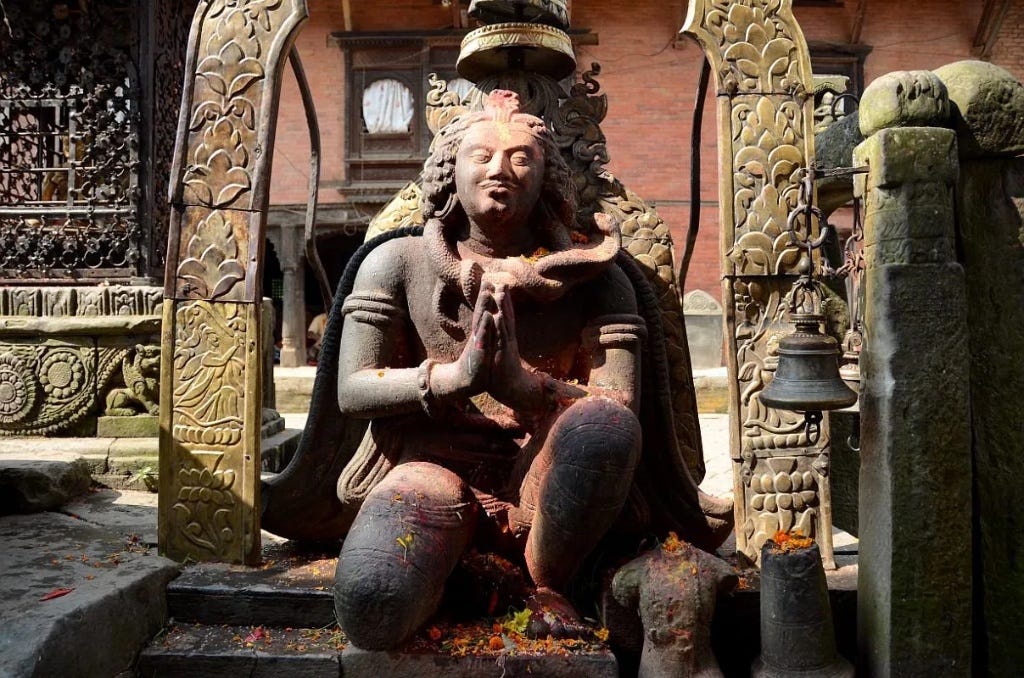
Fig: This statue once crowned the pillar on which the inscription is engraved. Sometime in the 19th century it fell down to its present location and the pillar was instead crowned with a gilded lotus. Art historians have long suspected that the figure depicted is of Mānadeva himself which I find quite plausible.
The part of the inscription that we excerpted, though couched in fancy words, is not very complex or hard to follow. The old king suddenly dies and the queen tries to follow him. That is, as far as I know, the earliest epigraphic depiction of the horrible custom of satī. The son in turn threatens to kill himself and the queen, threatened by these words, continues to live.
Whether or not these events took place exactly as depicted is a moot point. Presumably the death of the old king and the succession of Mānadeva are true. In any case, these praśasti-s are, in contemporary terms, unabashed propaganda pieces that aim to portray the kings in the best possible light. Still, the inscription is weird even by the stereotypical standards of praśasti-s. These usually consist of a genealogy of kings or other notables who are characterized in the most hyperbolic of terms. Conversations, especially those beyond simple imperatives, are quite rare in the epigraphic corpus not only in Nepal but over the breadth of the Sanskrit cosmopolis.
It is also unusual in the sense that the death of King Dharmadeva is abrupt. Judging by the length of the subsequent reign of Mānadeva (more than forty years, 461-505, though later sources usually ascribe a reign of 41 years to him and some modern scholars accept the reign of 464-505) as well as his depiction in the eulogy here, Mānadeva probably was in his twenties. In that case, his father must have been in the forties or fifties at most, certainly not old enough for a natural death. The death of Dharmadeva is also couched in flowery euphemism, “the king went to his place in the third heaven, as if he had gone to the royal garden”. There is no mention either of war or disease which one would expect here. The text, in fact, gives an impression that something is deliberately being hidden, or at least omitted.
This impression is further solidified by separate inscription. This one, at the great Buddhist Stupa at Svayaṃbhū, is worn out at places, is missing a lot of letters and consequently the date as well. It is nevertheless clear that it belongs to Mānadeva’s reign, probably quite late in his reign. Among a string of superlative attributes to the king like “fearless in war”, “proficient in arts”, “loving” and so on, there occurs a curious expression: “pitṛnimittapātī” or “grieving for (his) father”. Makes one still more suspicious, doesn’t it?
We had previously made mention of a vaṃśāvalī discovered by Cecil Bendall. This text, which was once called Bendall-vaṃśāvalī but is nowadays often called Gopālarājavaṃśāvalī after the name of the first dynasty, was composed from earlier, discrete, sources about the years 1385-1390. Though the exact dates down to the day start only from 1056, it does include the names of kings with their regnal years from the very beginning.
Mānadeva, as would be expected, appears briefly in its account the content of which is interesting to say the least.[4]
King Śrī Viśvadeva (Vṛṣadeva ?); 100 years. He consecrated the Caitya Bhaṭṭāraka in Sinaguṃ Vihāra (Svayaṃbhū). A stone water-conduit was also constructed there. On the norther side of the shrine of śrī Paśupati, a big trident was consecrated. He died as he was beheaded at night by his own son by the side of the water-conduit. This was done at his father’s command.
His son was Mānadeva; 41 years. He killed his father unwittingly. As he had committed such a monstrous crime, he wandered crying (in consternation). On reaching the hillock of Guṃvihāra he observed penances. By the merit of these penances, a great Caitya emerged (on the hillock). He consecrated the Caitya. There much land (area?) belonging to the monastery …
He founded Mānavihāra after his name. There he consecrated (the temple of ?) Śrī Māneśvarīdevī. He regulated the system relating to land-measurement and land rent. There was a big disturbance during his rule. In order to propitiate it, the Holi festival was observed on the day of Pauṣa Pūrṇimā (full-moon day of the month of Pauṣa). This subsided the disturbance.
You need not be an expert, in Nepalese history or in anything else, to spot contradictions here. Even if we disregard the impossibly long reign or the mythical matters, things do not add up. Mānadeva’s father, as we have seen from the contemporary inscription above, was Dharmadeva. There seems to have been some shuffling so that Dharmadeva is actually listed here as the grandson of Mānadeva and his father listed as a certain Viśvadeva. Viśvadeva seems to be a scribal error for Vṛṣadeva who, though we omitted it above, is listed as the great-grandfather of Mānadeva in the inscription we quoted in the beginning.
In 1957, the historian Luciano Petech discovered a new vaṃśāvalī in the private library of Field Marshal Kaisher Shumsher. It seemed to be based, at least for the earlier parts, on more trustworthy sources but was unfortunately very fragmentary and does not, cover the period that we are interested in here. It was only in 1985, after even the second and expanded edition of Petech’s Medieval History of Nepal (published 1984) was published, that a new and complete manuscript of this text was discovered in the National Archives by historian Kamal P. Malla. The main part of the manuscript was probably written early in the 1600s while a later hand updated and brought it to the 1790s at the end. This new text does cover the period we are interested in and, what’s more, seems to get the order right too unlike the Gopālarājavaṃśāvalī. Here’s what we get:[5]
… King Śrī Dharmadeva, 51 years; he commissioned the big south-facing pedestal with a bull on the top at the shrine of Paśupati. also founded the caitya bhaṭṭāraka of Dasana. Thereafter, Śrī Mānadeva, who was an adopted son not born in the family, became the king, 39 years. He had a vision of Svayaṃbhūcaitya bhaṭṭāraka (in his dream?). He founded Mānavihāra. He built the capital city and the palace Mānagṛha, with seven courtyards/storeys and two oblong lakes/ponds … surrounded on all four sides with … He became the sovereign of Nepal. Inside Mānagṛha.
(Folio 5B) he constructed a temple for God which had been excavated with gold/ for the God The King’s wife Bhoginī emmolated herself on the funeral pyre of the King. In Mānavihāra, the copper-plate roof he had built earlier was enlarged, and the land endowments of the monastery, too, were increased. He himself founded/initiated the use of a new epoch era.
This one seems to be, as far as we can check with contemporary sources, unusually faithful to actual history. The names of the kings are in correct order. Mānavihāra and Mānagṛha were indeed established by Mānadeva. The name of his wife truly was Bhoginī. Even the details about the seven-storied palace and ponds can be verified by the memoirs of the Chinese Buddhist monk and traveler Xuanzang - the inspiration for the protagonist of the classic Chinese novel Journey to the West. The mention of the queen’s name is also interesting because, as far as I know, her name occurs in no source anywhere for a thousand years after her time before it appears here suddenly in the 1600s. The ascription of a new era to Mānadeva is incorrect but it is an understandable error: a later king of the same name started a new era which started in 576 AD which was in use for some centuries.
All these give an air of authenticity. It seems that even as late as the seventeenth century, some older, more authentic, sources of history were available that must have been older even than those used by the composer(s) of the Gopālarājavaṃśāvalī in the late fourteenth century. What would I not give to have them today! But the tides of time sweep everything along, never to return and one can but dream of such things.
In this context, is it not interesting that the text specifies clearly that Mānadeva was not the biological son of Dharmadeva but was in fact adopted? There is no other word on it. The writer does not imply that the adoption means that the old dynasty ends and a new one starts. On the contrary, the same dynasty is presented without any disruption. Although arguments from absence are always dangerous, I would personally guess that the writer knew of some version of the human-sacrifice story and passed it in silence but not without indication that he was not unaware of it. The mention of the bare-bones of that story in the Gopālarājavaṃśāvalī as we saw above at least proves that it was not unknown.
Unlike the short texts of earlier times, the _vaṃśāvalī-_s of the eighteenth and nineteenth centuries are many and extensive. They are extensive narratives and for the more recent past quite detailed. Some of these, updated down to the late 1800s, even contain a brief history of the Napoleonic wars in the context of Prime Minister Jung Bahadur Rana’s visit to France in the 1850s[6]. For the earlier periods, however, things now get even more muddy. All sorts of mythical and legendary matters are introduced, mixed and removed so that if we did not have the help of ancient inscription telling of the genealogy of kings as well as the Gopālarājavaṃśāvalī, it would have been more or less impossible to tell any fact from fiction before deep in the medieval period.
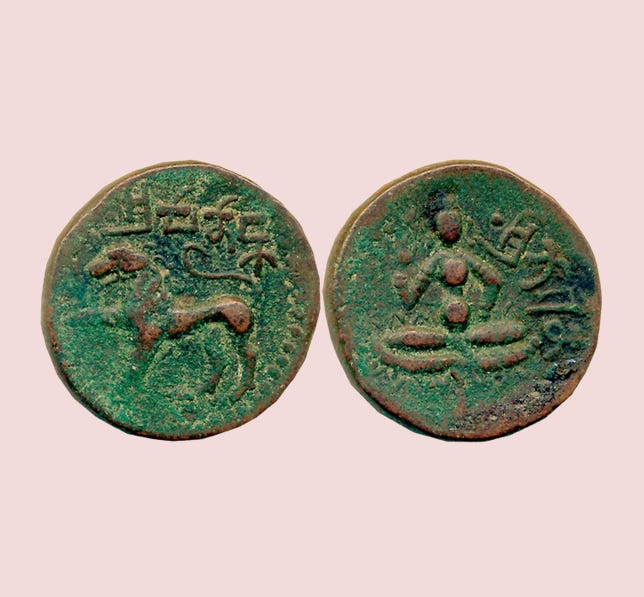
Fig: A coin from Nepal. 5th-7th century. The legends are mānāṅka (obverse) and bhoginī (reverse) respectively. The legends on these coins usually lead one to believe that they were issued, or at least started, under Mānadeva though some scholars date them later to the seventh century. Source.
The following story, whose chronology is all over the place and whose characters are based on pre-existing popular legends that have hardly anything to do with Nepal, is taken from one such vaṃśāvalī current in the nineteenth century as translated in Wright’s History of Nepal:
Having installed his son Vikramakeśarī on the throne, he died at Maṇi Joginī.
This Rājā was also very punctual in observing, and much devoted to, the rules and ceremonies of his religion. He built a durbar nine stories high, and surrounded the city with gardens and a wide ditch. He also appointed a day for his subjects to observe the Devalī Pūjā. Some time after this, he was much grieved at seeing the memorial of his forefathers, the Nārāyaṇa fountain, become dry; and he therefore went to Buḍhānīlakaṇṭha for advice. The deity told him to consult the astrologers. He did so, and after some deliberation they said that it required a sacrifice of a human being possessed of the thirty-two attributes. The Rājā resolved to obey these directions; but, thinking that to sacrifice a subject would be a sin, and to kill his own son, who possessed all the requisite attributes, would be cruel, he determined to be himself the victim. He therefore called his son Bhūpakeśarī, and ordered him to kill, without looking at his face, a certain man, whom, on the fourth day after that, he should find lying covered over on the fountain. The prince, going there on the appointed day, in accordance with his father’s commands, and not knowing who the person was, cut off his head. Blood rushed out of the dhārā, and the crocodile on the fountain turned back his head that he might not see a parricide. The son then went to wash his hands in the Īkṣumatī river, and was surprised to see swarms of worms floating in the water. On returning to his house, he heard a great noise of people shouting out that the prince had killed his father. The prince then silently performed his father’s funeral ceremonies, and making over charge of the government to his mother, he went to Maṇi Joginī to expiate the sin of parricide. Seeing him very forlorn, the Joginī informed him that he could expiate his crime by building a large Buddhist temple, two miles in circumference, and having four circles of gods. The spot for the temple would be indicated by the perching of a kulang (crane), which would take its flight from that mountain. The bird accordingly alighted, the spot for the temple was marked out, and the work was begun.(I have modernized the orthography for names.)
This incident shares the same basic plot with the story of Mānadeva that we had seen in the Gopālarājavaṃśāvalī. A son unknowingly kills his own father. The whole thing is not only done with the knowledge but also the express order of the father. There are necessarily details here in the longer narrative that were missing in the almost list-like text of the Gopālarājavaṃśāvalī.
That said, we are obviously far from the historic world, however misremembered, and deep in the world of legend now. It would seem that the story of Mānadeva was attributed to a popular legendary hero instead. Famous folkloric characters all over the world tend to attract unrelated stories and over time become more and more distant from whatever historic core there ever was. Sometimes even the names change and we can no longer conclusively say that a folkloric, mythical or legendary character was based on a historical person.
Even the name of Mānadeva seems to have been forgotten by the nineteenth century.
Or perhaps not. For the History of Nepal immediately continues with :
Another version of the story is, that it was Rājā Vikamatī who was sacrificed, and that his son Mānadeva was the parricide. The parricide, not being able to disengage his hand, to which the severed head attached itself, went to Maṇi Joginī, by whose advice he built the Buddhist temple, and then the head became detached; which head (i.e. an image of it) is seen to the present day at Maṇi Joginī.
This makes it clear, at least to me, what could only be suspected beforehand: that the story of the parricide was indeed transferred to other characters from Mānadeva which is, as far as such terms can be used for any folktale at all, the original tale.
Other nineteenth and twentieth century texts frequently tell this new and expanded story with hardly any new details and it would hardly be useful including them here.
Now that we have passed through the entire development of the legend, it would not be amiss to conclude with the question of whether there is actually something behind the legend at all. The best answer as far as I can tell is the simplest one: we don’t know and don’t have the evidence of knowing at all. The contemporary inscriptions do seem a little suspicious in their wording but that is a far cry from the tales of our sources, even the earliest of which is around a millennium after the purported incident. There are a few Tibetan sources which hint at the patricide story being known a little earlier but even then there is a large gap. These sorts of legends often get transferred from one popular name to another, as we have seen was the case even in our own tale, and it is entirely possible that it could be in its origin a simple folktale that just happened to get attached to a famous ancient king.
I do think there is something behind the tale but what that was we know not now and probably will never know.
फेरी भेटौला
If you like my writing, please subscribe to receive similar posts in the future. If there are any errors on my part, I would be grateful to have them pointed out in the comments. Thank you.
BIBLIOGRAPHY
Indraji, Bhagavanlal, and G. Bühler. “Inscriptions from Nepal.” The Indian Antiquary, vol. 9, 1880, pp. 163–66. [Link]
Malla, Kamal P. “Nepālavaṃśāvalī: A Complete Version of the Kaisher Vaṃśāvalī.” Contributions to Nepalese Studies, vol. 12, no. 2, 1985, pp. 75–101. [Link]
Petech, Luciano. Mediaeval History of Nepal (c. 750–1482). 2nd rev. ed., Istituto Italiano per il Medio ed Estremo Oriente, 1984. [Link]
Riccardi, Theodore, Jr. “The Inscription of King Mānadeva at Changu Narayan.” Journal of the American Oriental Society, vol. 109, no. 4, 1989, pp. 611–20. JSTOR. [Link]
Salomon, Richard. Indian Epigraphy: A Guide to the Study of Inscriptions in Sanskrit, Prakrit, and the Other Indo-Aryan Languages. Oxford University Press, 1998. South Asia Research. [Link]
Vajrācārya, Dhanavajra. Licchavikālakā abhilekha. Kirtipur, 2030 VS. [Link]
Vajrācārya, Dhanavajra, and Kamal P. Malla, editors. The Gopālarājavaṃśāvalī. Franz Steiner Verlag, 1985. Nepal Research Centre Publications 9. [Link]
Indraji and Bühler, "Inscriptions from Nepal," published in volume 9 of The Indian Antiquary. ↑
Salomon, p. 152. ↑
Riccardi, p. 617. ↑
The translation is from the edition of the text by Vajrācārya and Malla, pp. 123–24. ↑
The translation is from Kamal P. Malla’s article, pp. 96–97. ↑
This appears in a vaṃśāvalī that was serialized as "Nepāla Deśako Itihāsa Saṅgraha" in Ancient Nepal, nos. 12–27. Link ↑